


Heavy lifting builds the strength behind every jump and sprint. But during a grinding competitive season, all that mechanical load piles onto athletes who are already worn down from games and practice, and at some point it stops helping and starts hurting. So what if you could keep training explosive power without the wear and tear?
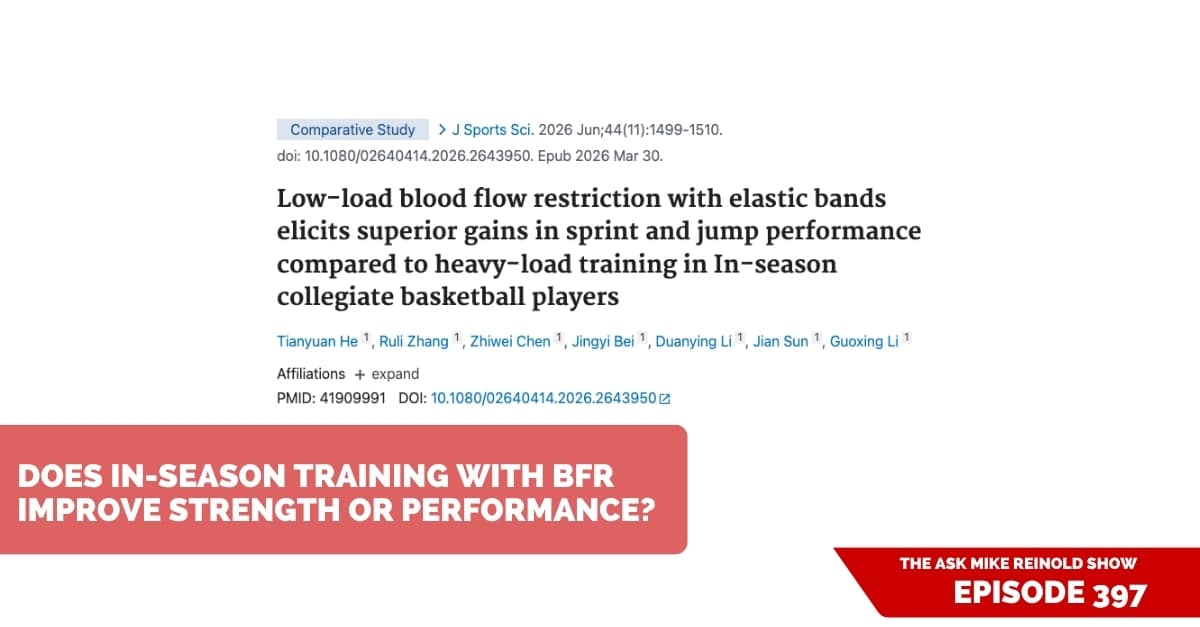
A new study out of the Journal of Sports Sciences put that question to the test with Division I basketball players in the middle of their season. One group squatted heavy the traditional way. The other squatted light, around 30% of their max, with blood flow restriction cuffs on their thighs. Eight weeks later, the results were not what most of us would predict.
The light group didn’t just keep up. On the two qualities that matter most for a basketball player, jumping and sprinting, they came out ahead, and they did it with a fraction of the physical load on their bodies. That last part is what makes this interesting for anyone managing in-season athletes.
But before you throw out the barbell, there’s a catch in how the study was built that changes how much we can actually conclude, and one detail in the numbers that’s easy to oversell. I get into both on this week’s episode, along with exactly when and how I’d use this with in-season athletes.
Check out this week’s podcast for the full breakdown.
To view more episodes, subscribe, and ask your questions, go to mikereinold.com/askmikereinold.
#AskMikeReinold Episode 397: Does In-Season Training with BFR Improve Strength or Performance?
Listen and Subscribe to Podcast
You can use the player below to listen to the podcast or subscribe. If you are enjoying the podcast, PLEASE click here to leave us a review in iTunes, it will really mean a lot to us. THANKS!
Show Notes
Transcript
Mike Reinold:
Welcome back, everybody, to the latest episode of The Ask Mike Reinold Show. We are here at Champion PT and Performance, answering your questions, actually reviewing an article. We’re going to review another article today. We got a great article today. Dave Tilley, Anthony Videtto, Noah Sprinkle, Lenny Macrina, here for you today. Along with Brendan Gates, who will be taking the lead on our article. Let’s see, what do we have for an article? I’ll help. I’ll start it off for you, Gates. The article is from the Journal of Sports Sciences, and the title is “Low-load Blood Flow Restriction with Elastic Bands Elicits Superior Gains in Sprint and Jump Performance Compared to Heavy-Load Training in In- Season Collegiate Basketball Players.” Good. I like that. I think that was just a nice, strict study. But check out that article, there’s a link to it in the show notes.
Brendan, what do we have for review of the article today?
Brendan Gates:
Appreciate you taking the title on that one. That was a mouthful. But yes, good study. It was a randomized control trial. They looked at 18 NCAA Division 1 male basketball players during an eight-week competitive season. The question that they were looking to answer was, “Can we improve or maintain athletic performance during the season while reducing mechanical loading?” And so the authors, they mentioned how they know heavy resistance training is great for strength, but it can also create quite a bit of joint stress and fatigue. They wanted to know if squatting with low-load combined with BFR could produce similar or better performance adaptations than traditional heavy loading. And so what they did was they basically took two groups… They had these two groups randomized, and they trained twice per week for eight weeks while continuing their normal basketball practices and games. I think highlighting the fact that this is an in-season study is good context.
They had the first group use BFR, and they used a lower-load squat. They were doing 30% of their one rep max, they followed a set rep scheme of one set of 30 reps, followed by three sets of 15 reps with 60 seconds of rest in between. The BFR cuffs were inflated to 180 millimeters of mercury, and that came out to about 60% to 80% limb occlusion pressure. They just standardized that pressure for every athlete, and it fell somewhere within that range. The heavy loading resistance training group squatted 75% of their one rep max, they did four sets of eight to 10 reps, and they had three minutes of rest in between.
Interesting wrinkle is both groups had… Back squats was the main thing that they looked at, and they had bands to them as well. They calibrated the bands to have about 10 kilograms of resistance at the bottom of the squat and then 25 kilograms of resistance at the top of the squat. And then they loaded the barbell with normal weights so that the total resistance averaged either 30% or 75% of their one rep max, based on the group that they were in. They then looked at, over the season, how their counter movement jump, their squat jump, their RSI, their 30-meter sprint time, their squat run rep max progressed. They also quantified the total mechanical loading over the eight weeks.
What did they find? They highlighted the difference in mechanical loading as the biggest one. The BFR group accumulated roughly 12,500 kilograms of total squat volume over the eight-week period, where the heavy load group accumulated roughly 44,500 kilograms over the eight weeks. That’s about 3.6 times more mechanical loading in the heavy group than the BFR group. They looked at jump performance. Squat jump and RSI did not differ between the two groups, but there was an interesting difference in the counter movement jump. The counter movement jump improved 3.4% in the BFR group and 1.8% in the heavy load group.
When they looked at the sprint times, the BFR group improved their 30-meter sprint by 0.8%. The heavy loading group increased by 0.2%, so the BFR group improved significantly more compared to the heavy loading group. Strength wise, both groups got stronger and roughly about the same amount. They said that both groups improved their squat room at one rep max by roughly seven to eight kilograms. Both got stronger, just one had to lift lighter weights. An interesting part was perceived effort. You might think that the BFR group, because they’re lifting less weight, might think it’s easier. They reported that the RPE was the same between the two groups. Even though they were lifting less weight with the BFR on, the athletes reported feeling like they were working just as hard despite the substantial reduction of mechanical load on their bodies.
What does this mean? I think, essentially, if we want to see a decrease in mechanical load and joint stress, training in-season for athletes can be a viable option. It can also reduce some of that systemic fatigue that we want to manage as we are playing high level games, practices, conditioning sessions. This might be a way to minimize that while you have stress from other parts of your sport. The paper points out that this does not replace heavy loading. It actually touches on the benefits of it, and they talk about how it’s important for tendon stiffness, bone health, and long-term athletic development. But it gives us some evidence to say that BFR in-season instead of traditional heavy loading could help with a high volume schedule with a lot of games. It could be helpful in de-load weeks, maybe certain athletes who are playing heavy minutes and we want to make sure that we’re not overloading them. Maybe athletes with irritable joints, we have less stress on them. It could potentially help in the return to sport progression of not overloading from a mechanical perspective.
Interested to hear your guys’ thoughts on this. Let me know what you guys think.
Mike Reinold:
Awesome. Thanks, Brendan. Great review of that article. And again, I like how this answered some very specific questions, not broad strokes, which is really cool. In-season, I actually like how it was basketball. If there was one sport where I think mechanical loading of ankles, Achilles, knees is super important, it’s probably working with basketball players. I thought this was really cool. The part that I was excited about, I guess, is that not only did they have similar strength maintenance, but the BFR group actually showed improvements in performance too, which I thought was pretty cool to see. I think this is really cool. I think we’re going to start seeing this more and more. But what do you guys think? Who wants to jump in? Anybody play with this a little bit? Anybody have any concerns? Anything they want to do different? What do you guys think?
Anthony Videtto:
Yeah, I thought it was an interesting study because as a PT and as a clinician, I feel like we’re using BFR when patients can’t tolerate load. That’s the main reason that we use BFR at Champion, at least. To see it used in a healthy population for performance benefits, I think that’s super exciting. And really curious to see where this takes us in terms of that whole sports performance realm, especially in-season if we are trying to manage workload and all that type of stuff. The only question I had was that when we’re looking at the protocol, in terms of the set and rep scheme for the heavy load group, doing four sets of 10 is super fatiguing.
I think if we asked any sports coach or collegiate strength coach out there, they’re probably not dosing four sets of 10 for squats in-season. I think that’s going to be probably detrimental to their sports performance. It is interesting to see that they got stronger throughout the course of the season, but I’m curious to know… Were there any other metrics that we could look at in terms of fatigue? We talked about jump height. I think we would see maybe a decrease in jump height over time if we were doing four sets of 10 for all these exercises. I thought that would be curious to know in the future, if we could go from four sets to 10 to maybe a more specific in-season protocol, probably four sets of five, a little bit less volume in total. But yeah, overall, I thought this was super exciting in terms of the fact that BFR might have more use than just for someone who’s injured, but we might actually use it for sports performance at some point in the near future.
Mike Reinold:
Yeah, that’s great, Anthony. That’s a really good point too because I think we could say that BFR is helpful. We like the outcome so you can use BFR. I think we’re excited about that. But to your point, saying maybe there’s a more optimal way to do a heavier load, maybe we can’t rule out that heavier load is bad, maybe just four sets of 10 is bad based on that, which is really good. But awesome. Len, what do you think?
Lenny Macrina:
Yeah. Overall, interesting paper. The N is very small, only 18 total. So probably nine per group, I would guess, is what it was, so you got to take that with a grain of salt. I think also using a standard cuff pressure of 180 for everybody… Who knows what that means for each person is one thing. I think also the 30, 15, 15, 15, 75 reps, that’s a lot of effort for somebody to do. Just from that, they could get changes. And then also one final thing. I wish there was a better control group, meaning somebody who did nothing or just did body weight, or something, would be a better comparison for my understanding of the conclusions that they drew from this. I think we’re onto something, but I think we need more data than just what they are providing in this paper. But overall, in any study that is performed, I applaud them because it’s an effort and it’s not easy. And so good job helping us understand it a little bit more.
Mike Reinold:
I like that. And anytime they change the set rep schemes and the two groups have different set rep schemes, to me that always bothers me in a research study because was it really the BFR or just that they did 75 reps? That’s a lot of reps. I always wish they did that. But again, at least we’re comparing two protocols, and at least we have one that was effective. And I think that’s why we like the study. If things were ineffective, maybe we’d be more critical in saying, “Wow, I wonder if there’s a better way to do it.” But what else? Dave, what do you got?
Dave Tilley:
Yeah, my two cents… I really liked the article. I think it was cool to see, again, in-season, how you can maintain or build some power even when someone is taking quite a high workload. I think the big thing for me is… BFR I think is an amazing tool, and it’s great, but you have to have the right context for what you’re trying to do. To Anthony’s point, early post-op, we’re two, three weeks out of ACL or a knee injury, and we like BFR because it allows us to maintain or increase strength of muscles in the leg while we’re intentionally trying to limit mechanical loading through a bone drill site, a graft site, a patellar tendon harvesting site. In that context, we’re intentionally trying to strengthen the quad because we don’t want to stress the tissues that are healing. But it never replaces good old-fashioned loading because you can’t just strengthen someone’s quads and their leg muscles, but send them back with a patellar tendon or bone stress that has not been Wolff’s law-adapted to load if you expect them to jump and run and take force. That’s one context.
But in this context, it’s great because the opposite is happening… Is that we want to maintain or grow hypertrophy and intentionally not overload joints or things that maybe are already on the brink of high workload-based overuse injuries. Think about patellar tendon jumper’s knees, the most classic basketball in-season injury that somebody has. The patellar tendon is screaming because it has too much of a high workload, or maybe it didn’t have enough prep and ramp up in the offseason. If we’re in season and we’re trying to maintain sports performance, explosive power, but limit stress to the patellar tendon to not push it over the edge, this is a great example of when it’s good. And BFR is the opposite. We’re intentionally trying to spare the passive structures, the tendonous tissues, the cartilage, to get a training effect. Whereas early BFR, we’re doing the quad without loading the tendons or the structures that we’re worried about.
It’s cool to see the application of a tool in very different situations based on the goal. And I agree with Lenny. I think I read that global six to 80. It was like, “Oh, it’s correlated to this amount of pressure.” I’m like, “Yeah, but there’s a reason that Dopplers exist to get a very specific limb occlusion.” You have one dude who’s 180, one dude who’s 210, 5’4″, 6’4″, it’s completely different to make sure they’re all occluded the right way. I agree with that in a small sample study, like Lenny said.
Mike Reinold:
Especially in a research study, I think there’s some debate out there right now, how important occlusion pressure is. And it just depends on how you define important, but I would define a research study as important. I think that’s the one you have to be really strict. They also use the KAATSU bands, which I think do not fully occlude, if I’m correct, based on that. I hope I didn’t speak wrong on that one here too. Using maybe a different type of band might’ve been different too. But again, these are quality bands with a lot of evidence behind KAATSU, so those have some evidence behind it. But yeah, important.
Dave, one last thing you alluded to a little bit, but we talked at the very beginning of BFR when it first came out that we were concerned maybe that people wouldn’t be mechanically loading. This again is a really good example of basketball players. If they’re jumping on court for skill training as well as competition and you can remove that load, that’s amazing. Any thoughts on… I assume it’s a good thing workload-wise, but remember when we first talked about BFR, we were worried that we weren’t putting enough load. If we take load off in-season from tendons and joints and bones, that’s a good thing, right?
Dave Tilley:
Yeah, I think yes and no. I think you’re trying to… The workload world of things is you’re trying to just find the optimal dose that maintains a really high chronic workload without pushing someone over the edge. That’s Tim’s big thing. And I think it’s really important to know in the workload world… Is that the best thing that predicts hamstring injury in-season is how much high-speed running you did offseason and how long you ramped up. Did you do a four-week sprinting program and get a little bit of volume because you were scared the season was starting and you were on the beach too much this summer? Or did you do a 12-week graded overload program where you really ramped up slowly, you got a really high-speed chronic workload? That’s going to help you.
And the same things here as well. BFR is a great tool as an accessory piece, regardless of what you’re doing. Even in the rehab world, we don’t just come in, do soft tissue range of motion, and do BFR for 45 minutes. We want to load somebody as much as we can with force plates and do a kettlebell deadlift if they’re after post-op or whatever. We’re trying to load mechanically because you need that. You need bone, cartilage, tendon stress. But in this situation, if you’re in-season, you’re not only doing BFR jump squats to try to maintain your mechanical load. You’re playing basketball, you’re doing drills, you’re doing warmups, you’re doing a two-day per week, probably, strength program with a lot of accessory work. You’re playing with fire in-season because you can’t build more strength, and you’re trying to slow the rate at which somebody’s declining because the tendons only take so much over the course of a season.
Good workload management is about measuring and understanding what someone is going through and how they’re responding, but also using all of the things that we know can maintain someone’s athletic ability to keep them in the game. That’s the goal. They want to play. You want to have the most available players possible. And if you can have something like this that maintains their power but doesn’t put extra stress on the tendon load, that’s probably good because they’re probably playing basketball six days per week.
Mike Reinold:
Awesome. Yeah, love it, Dave. And again, just another reason why this is such an important study that we continue to learn some best ways for in-season management because that’s how you enhance performance. I think that’s amazing. Brendan, thank you so much for that review. I think that came out great, really good article. Check it out in the show notes below or on the website. If you’re listening to this on a podcast, you can check out the links in the show notes there. And yeah, we’re going to keep doing it. We’ve gotten some great reviews from our listeners on doing these journal article reviews, so let’s keep pumping them out because I think we all like them. We’re learning, we’re growing. I think it’s been helpful. Great job, Brendan. Appreciate it. And we’ll see you on the next episode. Be sure to subscribe so you get a notification when it comes out. Thank you.