

Ten weeks to start throwing after UCL surgery sounds like a miracle timeline, until you’re the clinician staring at a stiff elbow, a deconditioned arm, and a protocol that assumes the athlete is further along than reality. We’re seeing more internal brace UCL repairs and fewer “classic” Tommy John reconstructions, and that shift is changing how baseball pitchers, gymnasts, and other overhead athletes move through rehab.
We talk through what’s actually different about the internal brace procedure, why surgeons became so optimistic early on, and why many athletes still aren’t truly ready to throw at week 10 even if they’re technically cleared. Readiness means more than ligament stability. We dig into the practical stuff that decides outcomes: restoring extension early without creating inflammation, building real strength and arm care habits, and using a plyometric progression before a return-to-throwing program. We also share what we’re watching for clinically, including ulnar nerve irritation from prolonged bracing, motion that never quite “settles,” and the unique posterior-medial elbow pain that can show up with deep flexion or forced extension.
Most importantly, we argue for criteria-based rehab over calendar-based rehab. If the athlete has time before the next season, use it to build capacity instead of chasing an artificial milestone. If you work in sports physical therapy, sports medicine, or baseball performance, this conversation will help you spot red flags early and guide internal brace athletes with more confidence.
Subscribe, share this with a coach or clinician who manages throwing programs, and leave a review if it helps. What’s the earliest return-to-throwing timeline you’ve seen that actually held up long term?
To view more episodes, subscribe, and ask your questions, go to mikereinold.com/askmikereinold.
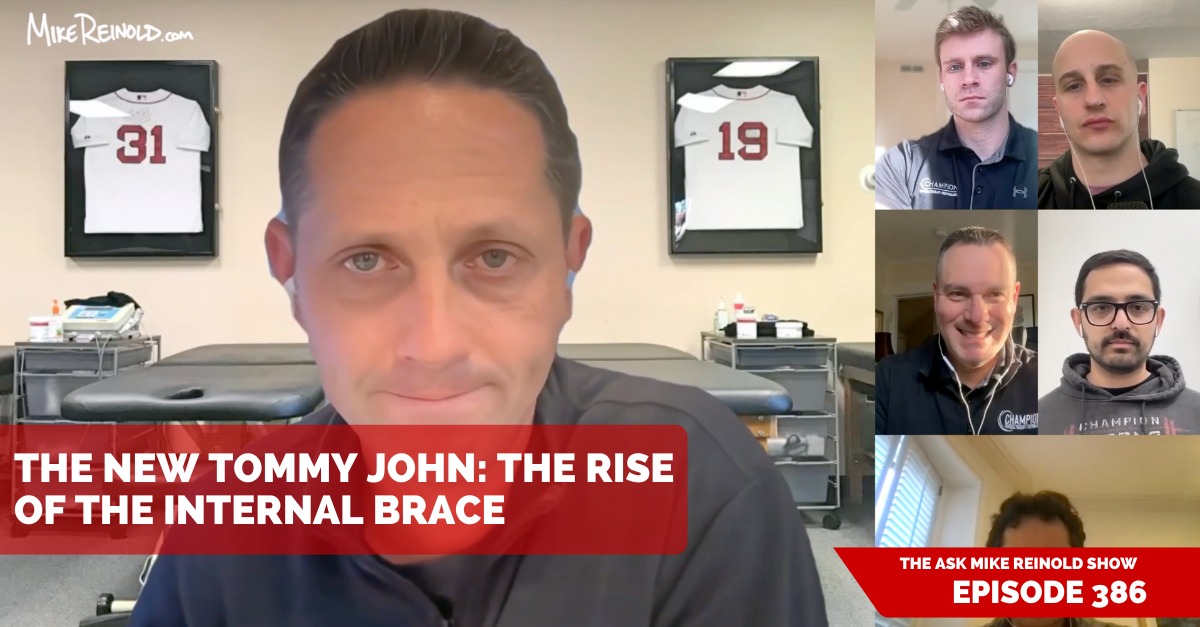
#AskMikeReinold Episode 386: The New Tommy John: The Rise of the Internal Brace
Listen and Subscribe to Podcast
You can use the player below to listen to the podcast or subscribe. If you are enjoying the podcast, PLEASE click here to leave us a review in iTunes, it will really mean a lot to us. THANKS!
Show Notes
Transcript
Mike Reinold:
Welcome back, everybody, to the latest episode of The Ask Mike Reinold Show. We are here at Champion PT and Performance up in Boston, answering your questions. Anything you want to talk about, just ask away. Go to mikereinold.com, click on that podcast link, and you can submit the form and really ask us anything. Sports medicine, PT, career advice, performance, anything you want to talk about, we are here for you. Let’s see. Who do we have today? We have Lenny Macrina, Dave Tilley, Brendan Gates, Diwesh Poudyal, and Anthony Videtto, all here for your listening pleasure today. No students. We’re playing with some new formats that we’re messing with with the podcast. So Len, I don’t know, do you have any opening statements since you don’t have the students to announce? You want to say hello?
Lenny Macrina:
No, I usually write the students down, and it’s blank, so I guess I was waiting for a magical arrival.
Mike Reinold:
You have a scratch pad there on your desk?
Lenny Macrina:
We have a whole PT department of students now, so I have to keep track of each one, like Gremlins.
Mike Reinold:
Yeah. All right. So, first question from today, I’ll be happy to read it. So, let’s see, Chris from Tampa, “We’re seeing way more repairs with internal brace lately rather than the standard Tommy John. Surgeons are clearing them to throw much earlier, and frankly, it scares me. Are we rushing these guys back too fast? What are the red flags you look for in these accelerated UCL protocols that differ from the traditional reconstruction we’ve done for decades?”
Good question, Chris. I mean, it’s funny, you could tell you’ve done this for a while just by reading your question. The traditional reconstruction, we’ve done for decades, I’m reading into it. So we have this new internal brace. Let’s start with this. I’ll lead some questions here. What do you think, in the last year in your guys’ caseloads … I know Anthony and Lenny, at least, and myself. I’m not sure, Brendan, how many you have over at your place. But how many internal braces are we seeing and not reconstructions? What do you think? What’s the percentage, you think? What do you think, Anthony?
Anthony Videtto:
I feel like it’s half for me. I’m seeing so much more of internal braces, especially in the college level. It’s so much more prominent than what I’ve been seeing in the past in terms of the reconstruction versus the hybrids. So that’s just me personally. I don’t know, Len, is that similar for you?
Lenny Macrina:
Yeah, I think it was a little less for me. My gut said like 30%, something like that. I have a couple right now that are isolated, but the majority are hybrids for me. Yeah, in my head…
Mike Reinold:
I feel like on my end, the reconstructions went to internal braces for a hot second, but then hybrids took over, so a reconstruction with internal brace. And now, I feel like they’re scaling back again, and we’re starting to see more internal braces and less hybrids again. But I would say the traditional Tommy John reconstruction is gone. It’s either an internal brace or it’s a Tommy John reconstruction with an internal brace or a hybrid. Anybody disagree?
Anthony Videtto:
I agree with that.
Lenny Macrina:
Yeah, I agree. Yeah.
Brendan Gates:
Mine is just all internal brace right now.
Mike Reinold:
No way, really. It’s just all internal brace? Yeah. So, it’s funny. I mean, what was our first internal brace, you think? 2013-ish? Is that what it was when Dr. Dugas down in Birmingham started doing internal braces, Len?
Lenny Macrina:
It was probably around there, yeah, 2012-ish, 20… Yeah.
Mike Reinold:
It’s funny. Were you scared?
Lenny Macrina:
Yeah. It all happened by accident. It was a Troy pitcher who just pitched earlier than he was supposed to and did well. So, I think we were like, “Oh, they can handle it.” Troy University, Dugus is the team doctor for Troy, and the kid just violated all the restrictions.
Mike Reinold:
If that’s the methodology, then I think we need to have a kid like that violate a traditional Tommy John and just make sure his…
Lenny Macrina:
That’s how we got ACL rehab advanced by the Shelburne paper in ’90. They all violated the precautions, and then they did well. So, yeah.
Mike Reinold:
I just remember it because the doctors were super gung-ho about this at the beginning. I think we’re starting to get them to scale back a little bit here, but they’re super gung-ho that they can go super fast, get back a lot faster. And we were just like, “Oh, man. This seems too fast for us.” I don’t know. What were your initial thoughts, Len? And then, as you went through the first people, what do you think? Were you still scared?
Lenny Macrina:
Yeah. Yes. I’m not scared anymore, but initially, in my head, you’re putting a tissue in that’s not the patient’s own tissue. And so, I thought it would take longer for that to incorporate, almost like an allograft, but even not. It’s not even tissue. It’s just material. So, in my head, I’m like, “Wow, we’re getting these kids to throw earlier with tissue that’s not theirs. I’m worried that it’s not going to incorporate into the bone and stabilize appropriately, and we’re just going to rip it out. ” And I was like, “Oh, we’re going to throw at 10 weeks?” If we have them do a slow or a regular rehab for the first four to six weeks, that gives us a month to basically get them ready to throw. And it felt like it was quick with healing and strengthening-wise. And I’m not doing a lot of throwing at 10 weeks, but 12, 14 weeks, we get an extra few weeks out of it, and they seem to hold up.
Mike Reinold:
It’s funny. You said that really well because I think we all shared the same concerns at the beginning with this, like, “Man, why are we rushing back to throw so fast?” To me, I guess we should probably start with the audience here and just say, “What’s the difference?” But traditional Tommy John, I would say, for the longest period of time, we started throwing at week 16. And in the past, I know Kevin Wilkin, in the 90s, tried week 12, week 20, tried a bunch of different things, but we settled on week 16. And I think week 16 was really there for a very long time. The physicians started to want to slow down a little bit, not really slow down the rehab in terms of starting to throw, I don’t think, but really in terms of the whole general rehab process.
And to me, I pushed them back to week 20 just because if you go week 20 and then you do a seven-month throwing program, which, by the way, is a very long time. A seven-month throwing program is very long. So, for these people, five months and seven months works out pretty good to a year, so we started doing that. Then, all of a sudden, as Lenny alluded to, internal braces come out. And the doctors, at the beginning, weren’t they saying eight to 10 weeks at one point, or did they say eight weeks at one hot moment?
Lenny Macrina:
I don’t know if I remember eight, but it was definitely 10. It was trying to just break the sound barrier of, “All right, we’re going to get you back faster. Let’s go.” And this is our selling point. We can get you back faster.
Mike Reinold:
Crazy. Man, 10 weeks. Wow! All right, so here’s a question. We’ll start with Anthony, and then Brendan, Len. Sorry, Dave. Dave’s…
Dave Tilley:
I actually have an internal brace right now.
Lenny Macrina:
Yeah. Hey, with gymnasts, they’re going to get…
Mike Reinold:
A dramatic one.
Lenny Macrina:
…it too. Yeah.
Mike Reinold:
The non-baseball players are actually perfect for this because a traditional Tommy John is an enormous procedure for them, when an internal brace is much better. All right, so let’s go to week 10. So, you’re week 10 on an internal brace protocol. How many times have you felt the person you were working with was ready to start throwing? What do you think, Anthony?
Anthony Videtto:
Never. Is that too direct? I mean, it’s so soon. They’re wearing the brace for mostly six weeks, and we’re just going to give them a month to get strong enough, get in the gym, and then maybe start applying metric progression. I don’t think a month is enough time to do all that stuff. And then, it’s starting with the end in mind. How many of these kids do we need to get back in seven, eight months? A lot of them are getting injured in the spring. Do we need them to be full speed off the mound in November, December? No. We have till the next spring to get them ready to go. So I think, situationally, it depends. But no, to answer your question, 10 weeks seems way too early in my head.
Lenny Macrina:
And in those kids, we tell them that ahead of time. You’re not going to throw at 10 weeks. You got hurt in March or April. We don’t need you to peak in November, December. Let’s throw it four months, something like that, and go traditional. And they all buy in because they know. They realize. Yeah.
Mike Reinold:
Just be careful. That just might not fit into the surgeon’s outcome study that they’re trying to publish.
Lenny Macrina:
Correct. No, I get it. Yeah.
Mike Reinold:
Because sometimes, that is part of that process with that. Yeah. I mean, I completely agree. And I actually think 12 weeks is… 12’s, I don’t know, probably what we’re saying we’re probably doing the most now. Somewhere 12 to 16 if we have time. I still think they’re not ready at 12 weeks. And if you think about a Tommy John person right now, that’s getting an internal brace, it’s probably what, a high school kid, maybe a young college kid? And trust me, you could do these on anybody. Don’t get me wrong, that’s not my point, but you get a lot of high school and college kids here. And you know these kids have never done an arm care program. They’ve barely worked out in the gym. Their mechanics are terrible. The first six weeks are damage control. And then, all of a sudden, you’re like, “All right, pick up a ball again.” It just doesn’t make sense.
I feel like we don’t have time to help this kid. And man, when we pushed back from week 16 to week 20 with the traditional Tommy Johns, I actually think the biggest benefit with that was how prepared their bodies were before they started throwing. To me, that’s what stood out. And I think that’s why our players have done so well. We went to week 20 years ago, before, I think, everybody else was, and it just really benefited. So, you have a kid that’s never worked out, not physically, completely mature, probably, no arm care program. And you’re essentially saying, “However you were when you got hurt is what we’re going to get you back to, and we’re going to throw again. We don’t have time to improve you.” So, Brendan, what do you think?
Brendan Gates:
Yeah, I just wanted to comment. I had a kid with an internal brace come in recently, a college pitcher. And with this short of a timeline, he missed the first three weeks because he got the surgery in California, and then he just didn’t come to PT for the first three weeks. So, with those three weeks, that’s significantly pushed us back a little bit. So, how much do you guys value getting the person into PT almost immediately?
Mike Reinold:
That’s actually great. I’ll start with that, just because I have a kid now that had an internal brace that started at week two, and he looks bad. Sorry, if you’re listening. It’s not that he looks bad. He’s behind where I would like him to be, to your point, Brendan.
Brendan Gates:
He’ll get there. He’ll get there.
Mike Reinold:
Yeah, exactly. So, his motion was behind. He wasn’t moving around. He actually has some ulnar neuropathy. And who knows? Maybe that’s from sitting in his brace, not moving. Maybe the brace was too tight on his ulnar nerves. There’s so many reasons other than just starting the rehab process where you want to go. So yeah, I even started week two, Brendan, and I thought they were too late. What do you think, Anthony?
Anthony Videtto:
Yeah, I have a kid who just came in who was nine days post-op, and same thing. Stiff. Was in the brace, locked for nine days, and was nervous to move his arm once we took the brace off. So, the importance of getting started in the first week is… Yeah, we can’t emphasize that enough.
Mike Reinold:
Yeah, completely. Completely. All right, Dave. Yeah, sorry Dave. What do you got?
Dave Tilley:
Yeah. I remember overhearing. Maybe Lenny can correct me, but I think… Weren’t you guys saying, too, that some of the concern is that the tape and the repair, the actual ligament is really too strong, and it’s very, very good. And the stress on the other parts around the elbow is what’s more concerning as kids are getting forearm flexor issues. Kids are getting… Lenny, didn’t you have somebody with a bone tunnel stress reaction? Is that part of the issue, too?
Lenny Macrina:
I would say so. The material is so strong, and I think the fixation is so good that we’re seeing more bone stress injuries. I’ve seen a couple of heterotopic ossifications, where you’re getting bone calcification formation that causes elbow stiffness. It’s not just me. I’ve actually spoken to a baseball player up at Colby College in, what is it, Maine? They’re having the same issue. Motion just doesn’t come back. And I threw that idea out at them. It could be this because you work on flexion, they lose extension. You work on extension, you lose flexion. It just doesn’t feel right, but he’s throwing, and he just keeps pushing through it, but there’s something underlying going on. He had a hybrid, if I remember correctly. And I just was like, “You’ve got to look deeper into this because you guys are missing something.”
Mike Reinold:
I was just going to ask that, Len, because I was going to say, “I’m not seeing that with internal braces.” Was that a hybrid? Because I feel like the hybrids I’m seeing a ton.
Lenny Macrina:
The hybrid, yeah. Sorry. Yeah, the hybrids. Yeah.
Mike Reinold:
The hybrids are just so tight, especially the surgeons are tightening them up so much, which is interesting there. In the mid-range of motion where they throw, they’re actually okay, but then, even 12 months after the procedure, they feel tight in flexion and extension, but they can throw. So, I don’t think the surgeons care because of that, but I don’t know. I think it bothers us. I don’t know. So let’s shift gears and talk about outcomes a little bit here because I think the exciting part of this is they’re doing great. I don’t have anything bad to say about internal braces. And for years, I said it’s promising. It’s looking good. But at this point, I think we can firmly say that this is a very, very viable procedure. It is very effective.
A recent study by Jeff Dugas and the group out of Birmingham last year showed that the outcomes were excellent, the same as traditional Tommy John. And I think what’s happening now is the surgeons are doing a better job diagnosing the specific type of injury in the right person for these procedures, and they’re giving them what they need. So the outcomes are great, so I have no concerns about this. Why don’t we end with the last part of this question and just say, all right, in your guys’ experiences through this rehab process, we talked about some of the things we find, what are some of the red flags? That’s what Chris asked for. What are some of the red flags, or what are some of the things like the pearls that’s different with this versus a Tommy John in your experience that you want to share with somebody that maybe hasn’t seen a lot of these internal braces? You want to start, Len?
Lenny Macrina:
Yeah, I think getting them in early and getting that motion right away, I think… I don’t know if doctors are getting more conservative with these or just in general, but getting them in early, get that motion, get the extension established. These things are fixated. The docs are not worried about anything. Get them moving. It’s not going anywhere. But don’t be too aggressive because I do see cases where I inherit cases from other people where they start to feel the stiffness in the elbow, and the clinician freaks out and starts really cranking on the elbow. And I think that creates more inflammation and more… And I think that’s probably a couple of reasons why you’re seeing, or I’m seeing some heterotopic ossification in a couple of mine that I’ve inherited. So get that motion, especially extension, but don’t be too aggressive.
And I think just get these kids, get their strength. Don’t just follow the 10-week or 12-week protocol. “They got to be ready to throw,” because it’s just going to make the rehab process that much easier when they are throwing from 90 and beyond, because that’s usually where you start to see them breaking down, because they just can’t handle those stresses when they get beyond 90.
Mike Reinold:
Brendan, what do you think?
Brendan Gates:
I think Lenny said most of the stuff that I was thinking about: getting in early, making sure not to push flexion too much. It seems like if you really crank on that flexion early, that gets them irritated and stiff. And yeah, I think, as somebody who probably sees a little bit less of the internal braces and Tommy Johns in general, I know for me, still ranging them so early at week six or week eight into that lay back position is a little scary for me. But I think we have to make sure, like you said, that we’re doing all we can to make sure they are appropriate for throwing a little bit earlier at that week 12 or week 14.
Mike Reinold:
Yeah. I agree, Brendan. It is scary the first time you do, it and you’re just like, “Ah, this seems so fast.” That’s the whole point of Chris’s question, too. I like it. Anthony, what do you got?
Anthony Videtto:
Yeah, just to emphasize what I said earlier, just because they can throw at 10 weeks doesn’t mean they should throw at 10 weeks. Starting with the end in mind is important. They have a lot more time than you probably think they do. And really, just take it case by case because, like I said, just because the surgeon says, “Yeah, throw at 10 weeks,” a lot of them probably aren’t going to be ready to throw at 10 weeks. So, use objective criteria, range of motion, pain-free. Make sure their strength’s adequate. Make sure they complete some sort of plyometric progression first. So yeah, 10 weeks, sure, but probably not, so let’s wait a little bit longer.
Mike Reinold:
Yeah. And I think I would just add, there’s a different pain characteristic that I think we’re seeing with these, especially when we’re pushing. It seems more flexion, but I’m seeing more extension lately too, where they actually point to the posterior aspect of their medial epicondyle, which is something nobody ever really has pointed with traditional Tommy John. That’s completely unique for me. And just keep in mind that I’ve seen… Again, you could throw no problem. You can do valgus stress testing, no problem. It doesn’t hurt. But then again, you push into flexion, and with deep flexion, you get that pain posterior medial.
Remember, that brace is like duct tape, it’s not pliable. Who knows? Maybe we’re pulling that on a little bit. And I think one of the things we’re still trying to learn here is, is the brace actually what’s helping, or is it the fact that the brace holds the ligament repair together better and allows the ligament to actually repair itself better? Maybe it’s not the brace a year down the road. I don’t think we know that definitively. So keep that in mind.
But yeah, I mean, to answer all your questions, Chris, this thing is good. We were scared. And I think Kevin Wilk, we talk about this all the time. We’ve seen a ton of these with Dr. Dugas. He was scared at the beginning, but they’re doing great. So, I think it’s awesome. I want to see more and more of these because I’m actually liking them better than the hybrids right now. So hopefully there’s more to come. Great question, Chris. If you have a question like that, head to mikereinold.com, click on that podcast link, and ask away. And be sure to subscribe so you can get notifications for our next episode. Thanks so much.