

If you treat young athletes, you have seen this note a hundred times. A 14-year-old gets referred for low back pain, and somewhere in the orthopedic report is the phrase “hamstring tightness,” presented as if it settles the question. Tight hamstrings, tilted pelvis, cranky back. Case closed. Go stretch.
It’s a tidy story. It’s also the kind of story that survives because it sounds mechanical and nobody stops to check it. And when you actually look at what the research says, the picture gets a lot more complicated in a way that should change how you evaluate these kids.
Start with the obvious problem. Almost every adolescent in the middle of a growth spurt has tight hamstrings. Bones outpace soft tissue, flexibility drops, and it happens to the kids with back pain and the kids without it. So if you’re going to call it a cause, you have to explain why the vast majority of tight-hamstring teenagers walk around perfectly fine. Then there’s the direction of the arrow. Does the tightness create the back pain, or does the back pain create the tightness?
That second question is where this gets clinically important. Because there is one specific scenario in adolescent back pain where hamstring tightness matters enormously, and in that scenario it is not something you stretch. It’s something you recognize, and it should send you looking somewhere else entirely. Miss it and you can spend six weeks on a mobility program while the actual problem gets worse.
On this week’s episode of the Ask Mike Reinold Show, we get into what hamstring tightness in a young athlete is actually telling you, how to tell the difference between short tissue, neural tension, and protective guarding, and the specific findings that should make you stop treating and start imaging. Give it a listen.
To view more episodes, subscribe, and ask your questions, go to mikereinold.com/askmikereinold.
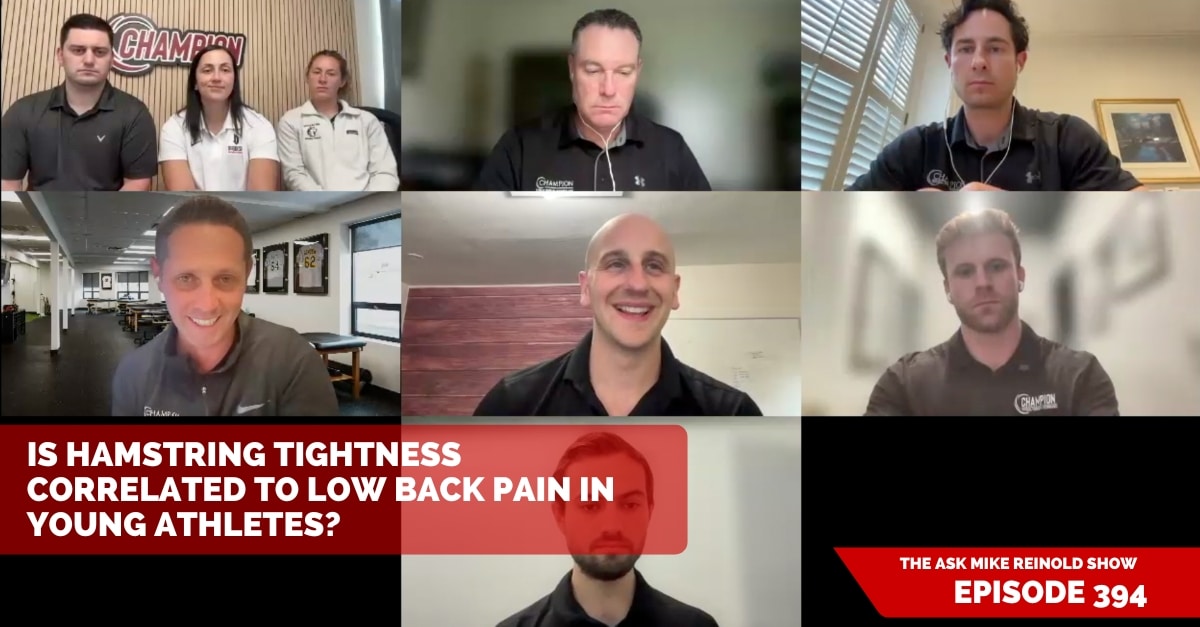
#AskMikeReinold Episode 394: Is Hamstring Tightness Correlated to Low Back Pain in Young Athletes?
Listen and Subscribe to Podcast
You can use the player below to listen to the podcast or subscribe. If you are enjoying the podcast, PLEASE click here to leave us a review in iTunes, it will really mean a lot to us. THANKS!
Show Notes
• Athletic Low Back Pain Rehabilitation Online Course
Transcript
Kylie Luca:
Okay. Steven from California asked, “I have many ortho surgeons refer kids with low back pain, and almost always in their notes it mentions hamstring tightness as a reason for back pain. In your experience and knowledge, how closely is hamstring tightness related to low back pain?”
Mike Reinold:
Ooh, this is a good one. I think Dave’s going to like this one. The first two things that jump to my head: how many of those surgeons do you think checked this kid’s hamstring flexibility? There’s no way they did, right? I feel like they also checked the box for ultrasound and e-stim on the referral thing too, but interesting.
So I like how this is phrased on kids, though, because I actually think that’s an important component to this here, and that’s how we’ll kind of phrase, I guess, this episode here. But is hamstring tightness correlated to low back pain in children, younger people? Dave, why don’t you start it off? Because I’m sure you might just start it and end it, but why don’t you start it off?
Dave Tilley:
Yeah, I’m going to say kind of, because it’s easy to just say that this equals back pain. There’s unfortunately a lot of times in the last, I would say decade, I can only say the last decade of research I’ve been reading, where something comes up in the literature, they test a bunch of people who happen to have a stress fracture or who happen to have flexion-intolerant back pain. They test a whole bunch of stuff, and they find that a good chunk of them have this. They have core stabilization problems. They have loss of hip IR. That was a big one for a while. They have limited hamstring flexibility.
And in kids, I think the thing that’s really important is that kids are growing at an extraordinary rate. The bones just cannot keep up relative to muscles. Muscles are stiff because bones are going so fast. So you have a kid who has a whole bunch of stuff going on. He’s playing a lot of sports. He’s doing zero strength conditioning program. He’s throwing with mechanics that look like the wacky, wavy inflatable man. He has no technical basis at all, and then he gets back pain. And then they test a bunch of stuff, and they’re like, “Oh, he has tight hamstrings. That must have caused his back pain.”
If that kid had had, I don’t know, a total arc that was 20 degrees more than average or less than average, they’re just like, “Okay, well, this caused his back pain.” There’s a lot of things that go in there. But that being said, I think if you look at it from a point of view of relative instability and/or maybe something’s moving more or taking more stress to make up for another thing, that tends to be something with flexion-intolerant back pain that might make sense.
So you take a kid who is growing a lot. He develops, let’s just call it, limited hip mobility. His hamstrings are stiff. His quads get really stiff too as well. And it’s hard for him to hinge well and not have some rounding in his back or have a high flexion angle of his trunk, maybe when he’s running, or maybe when he’s sprinting, or maybe when he’s starting a gym program. So they’re connected, I would say, but correlated is tough because the hamstrings didn’t cause his back pain. It was like his hips weren’t moving for many reasons, because he’s growing and he is getting stiff or he is playing a lot. He’s maybe not as strong, and he has some issues with his back.
The other thing I’ll say on the other side, and this is the last point, is I actually remember hearing this from Eric Cressey in 2023, when I was taking a seminar, or 2013. He was saying that he sees a lot of people who have overextended postures because they’re baseball players, they sprint a lot, they’re whatever. And that if you start to have back pain, your brain might try to react and pull you into a posterior pelvic tilt, and you’re yanking on your hamstrings all the time. So maybe there’s something there too as well with extension-based back pain that it’s more of a secondary protective thing. But again, I just gave five context situations that hamstring equals back pain.
Mike Reinold:
Yeah, and I think they’re all good. One of the first ones you harped on, I think, which was really good too, is that we’re specifically talking about children here. So when you talk about children, you talk about bone growth, and you talk about then muscle adaptation to bone growth. I think a lot of kids, when they’re going through growth spurts, you could argue have hamstring tightness or a flexibility issue. You see it all the time. And then they come in with low back pain, and wow, they must be correlated. Let me ask you a question, Dave, or anybody else, but is there a chance it’s the flip? Does back pain cause hamstring tightness? Everybody wants to say hamstring tightness, tightness causes back pain. Could it be the opposite?
Dave Tilley:
I think in that extension-based example, it makes mechanical sense. Whereas if somebody has a stress reaction or a facet syndrome or something like this, and they’re very overextended, the hamstrings being extra stiff could be a protective response to try to get them out of raging anterior pelvic tilt. I think I do see that amount, but I don’t see that kid when he’s healthy before he got back pain. Rarely.
Mike Reinold:
Exactly.
Dave Tilley:
I see that kid who walks in for an eval.
Mike Reinold:
Right. And theoretically, before he started swinging off a tee at max effort all winter, he also was tight.
Dave Tilley:
Low-hanging fruit. Low-hanging fruit.
Mike Reinold:
Right. Yeah, exactly. All right, I like that. Anybody else want to jump in? I mean, I got some other thoughts here too, but…
Lenny Macrina:
I got some. I got a thought or two, but a lot to unpack.
Mike Reinold:
Yeah. Please.
Lenny Macrina:
Why is a kid with non-specific low back pain going to a surgeon?
Mike Reinold:
That’s a good point. I was saying he’s friends of the family, we’ll say.
Lenny Macrina:
I’m going to say that. But then it’s just like, how did he determine that these hamstrings were tight? Just like a 90/90 leg raise, he just forced the kid’s leg into flexion. Oh, you’re a little tight. It’s an easy thing to find. But I do agree completely with Dave that — what caused it? Is it the cause or is it the result?
I know most kids, like Dave said, are growing. Their bodies are in shock. So you got to convince the parents oftentimes that, yeah, the hamstrings could be playing a role here, because that’s going to be the question. The parents will be like, “Well, we have tight hamstrings. We got to stretch his hamstrings out or her hamstrings out.” And you’re going to have to figure out a way to address that because that’s going to be their low-hanging fruit, is “we got to get these hamstrings loose.” So, figure that out. But a lot of what you’re going to do is going to be probably hamstring, quad, glute strengthening.
What put them in that position? Is it an overuse thing? Is there a spondy that we’re missing? Is there some kind of issue with overuse? Is the volume issue? So yeah, I’m going to stop there, and I’ll let anybody else take over.
Mike Reinold:
That was great. I love it. Gates, what do you got? Brendan, what do you think? I know obviously you work with a lot of different athletes and in a lot of different settings and stuff, but what’s your experience been with this?
Brendan Gates:
Well, I was just going to say the other box that always gets checked right next to the tight hamstring box is usually the weak core box. And I think going off of what Dave said and his experience with Cressey’s seminar, if we’re in a super extended position, just like the position of producing power like a lot of athletes, if we’re stuck in that anterior pelvic tilt and we have our hamstrings really lengthened, sure, maybe we have tight hamstrings. But also, a lot of kids have tight hamstrings with low back pain.
I think often as kids are learning how to play sports and learning how to move their bodies, core control can be something that gets the boxes checked for a reason. So I wonder if it’s a mix of, like we said, all the above. If the weak core correlates to tighter hamstrings, tighter hamstrings can correlate to a decrease in core control, especially if we’re playing rotational sport like baseball, across anything where we’re producing power in a rotational aspect.
I wonder if those are some things that are worth looking at in most people, and it seems to be, and then the topic of just volume. If these kids are just playing so many sports and their body’s capacity for these movements are just exceeded, you’re likely going to find a lot of these things get checked on those boxes. But I think it’s hard to say it’s just tight hamstrings. I think we’ve hopefully hammered home the point that it’s quite a bit of different things that kind of all tie into each other.
Mike Reinold:
Yeah, makes sense. And you bring up almost the concept of relative stiffness in my mind. The hamstring is relatively stiffer than the lumbar spine, for example, and just how those things interact. Yeah. I mean, this is definitely a broader topic. When somebody comes in with non-specific low back pain, it’s usually not one thing. It’s going to be a combination of things. That’s why, yes, you need to do a structural exam to look at the low back. Did you find anything structurally wrong?
But two is you also have to look at some of those other findings. So we call it that checklist of suboptimal things that you might find because then they start adding up. You might say, “Oh, he has really poor core control. He has tight hips. He has tight hamstrings, weak core,” whatever. These things start to add up, and they go together. It’s hard to say it’s one thing when it’s that deep.
One other question I have, I guess, before we move on here is, and I’ll go to Dave for this one just because Dave’s the athletic low back pain guy. At least we have a course online for that. But for Dave, does hamstring tightness correlate to any specific pathology more? So let’s say, for example, it’s not non-specific low back pain, maybe it’s a spondy. Are hamstring strains prognostic? I mean, not strains, tightness prognostic of spondys or anything like that, a real type of structural deformity?
Dave Tilley:
Yeah, I’m going to go with no. In the literature, I actually just did a huge lit review when we were making the course last year, and there are definitely some studies that show, again, more people in this cohort had tight hamstrings, and they also had back pain, that’s why they’re in the study. But I don’t think you can say tight hamstring equals flexion-intolerant back pain, multifidi spasm, disc herniation, sciatica, whatever.
I think, again, the only connection that you find is that people who are young have limited hip mobility if they play a lot of sports and they don’t take care of themselves. I’ve had kids who are literally at our gym stretching and doing soft tissue work every day, and they still grow two inches when they’re on a summer camp and they come back.
I have a kid today who literally has recurring growing strains. He’s a hockey goalie. Because every time he gets a little bit stronger, he then gets a lot taller and his legs grow a lot, and then now he’s doing really full splits on the ice. And it’s like, kind of makes sense why your groin might be sore. But his back is sore. I’m not saying that stiff groin equals back pain. It’s just that he’s growing, his hips are stiff, and he’s doing a ton of sports. He just wants to play and be just a kid. And his interest in strength and conditioning and 15 to 20 minutes of soft tissue work, in addition to his warmup, is not really high right now. He wants to play hockey and play Fortnite. That’s what he cares about.
Mike Reinold:
That’s the part that stinks about this for me, too, is you go through a growth spurt, you have these issues, you work really hard to get over it, and then you go through another growth spurt, and you have more issues. It’s really that 13, 14-year-old that is just the worst age for these overuse type injuries and growth-related injuries, these types of things.
I guess I’ll just end with one other thing. Lenny mentioned it briefly. You can’t not work on the hamstring tightness because the physician said it. They probably said it to the person. They probably told the kid to do it at home, that type of thing. So I think what we do is we educate how that’s part of the process, and it’s just one component of the process, and we probably have to put it all together. If all you did was work on your hamstring flexibility, you probably aren’t going to get better. But if you add that as part of a comprehensive program that looks at everything three-dimensionally, I think you’ll probably do a lot better, as Lenny mentioned.
Anyway, great question. I like ones like that there too, because I like when the PTs come in and they say, “I’m seeing a lot of this from physicians.” I think that’s good because that could be some trends. It could be their area, could be just trends from the physicians in general, but I think that’s a great one here. Assess, don’t assume. That’s something we always say, but it’s always deeper than that.
So, Steven from California, thanks so much for submitting that. If you have a question like that, again, head to mikereinold.com, click on that podcast link, and be sure to subscribe so you get updates on our future episodes. Thanks so much.