

Building a sports physical therapy practice used to follow a predictable playbook. You opened your doors, printed some business cards, and spent your Friday afternoons dropping off food at local orthopedic clinics hoping to get on their referral list. For decades, doctor relationships were the lifeblood of private practice growth. But the modern healthcare consumer operates differently. Today, even when a physician hands a patient a specific script, that patient immediately pulls out their phone to check Google reviews, Instagram feeds, and website content before booking an appointment.
This shift has created a massive fork in the road for early-career professionals and aspiring clinic owners. Is the classic physician marketing route dead, or is it still the most reliable way to build a sustainable caseload? On the flip side, does a massive social media footprint actually translate into paying clients, or is it just an expensive vanity metric that takes time away from clinical care? If you were launching a brand-new hybrid performance facility today with zero brand awareness, where should you actually spend your time and marketing dollars?
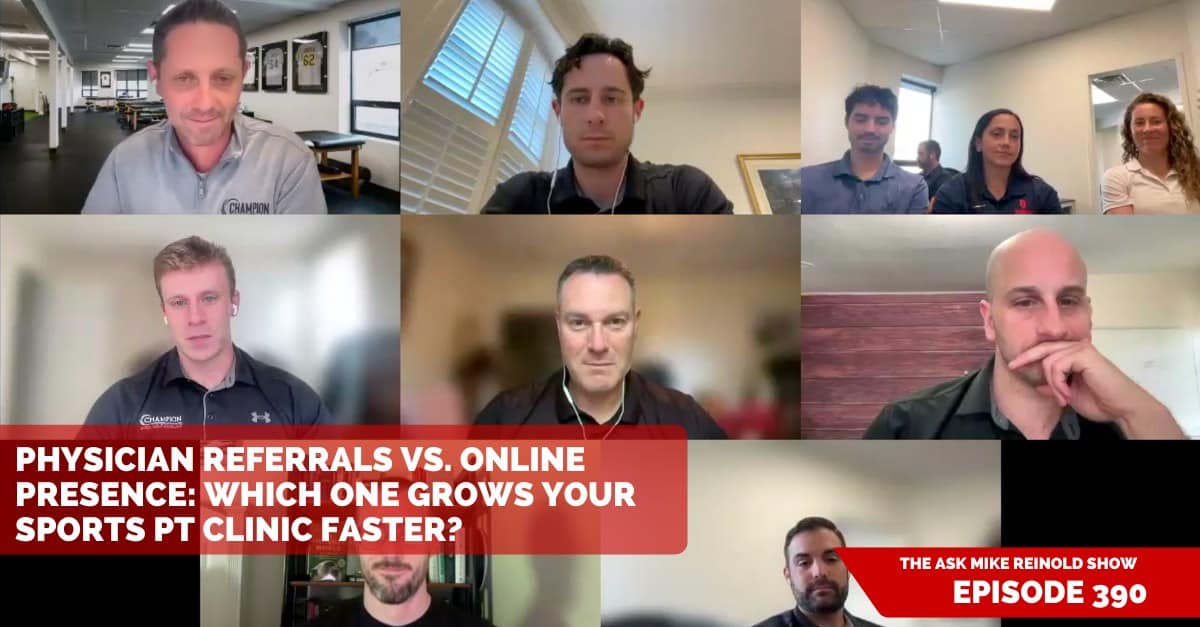
In this week’s episode of The Ask Mike Reinold Show, the crew dives headfirst into this exact dilemma. We break down the real-world math behind direct-to-consumer marketing versus physician networking, and share the exact strategy we would use if we had to start Champion from scratch today. Tune in to find out which avenue deserves your focus so you can build a thriving practice without wasting your time.
To view more episodes, subscribe, and ask your questions, go to mikereinold.com/askmikereinold.
#AskMikeReinold Episode 390: Physician Referrals vs. Online Presence: Which One Grows Your Sports PT Clinic Faster?
Listen and Subscribe to Podcast
You can use the player below to listen to the podcast or subscribe. If you are enjoying the podcast, PLEASE click here to leave us a review in iTunes, it will really mean a lot to us. THANKS!
Transcript
Caden Johnson:
Brian from Austin, Texas: “Hey, Champion. I’m a new grad PT with plans to open my own hybrid sports performance clinic in a few years. Historically, the advice has always been to go out and build relationships with local orthopedic surgeons to get referrals. But nowadays, it seems like patients ignore their doctor’s recommendation anyway and just choose whoever has the best social media content or online reviews. If you were starting a sports clinic from scratch today, would you spend your time shaking hands with doctors or building an online content brand?”
Mike Reinold:
Awesome. Great question, Brian. Caden, good job. Caden, that was like reading a bedtime story.
Dave Tilley:
That was the opposite of Caden’s normal excited personality.
Mike Reinold:
I was so comforted, that was just nice. That was nice, but good job, Caden.
I think that’s a really good question. And I think most of us here… We’ve had a lot of PT students come through our clinic the last 10 years that have went on and opened their own clinics and have done some of these sports practices. And I think they all have the same question. I think this is something that comes up all the time, and it’s kind of crazy nowadays. I’ll start with this, and then you guys jump in.
Nowadays, I do think this is real. You can be a young, inexperienced PT with an amazing online presence and get a ton of referrals. And this might be the first time in the history of our profession that that concept is possible. And not good or bad, but I’m just saying you could just have a better social media profile or a better online kind of presence, and you’ll be perceived as being an amazing physical therapist. Even though maybe there are clinics around you that are way more experienced. So I think take advantage of that as a unique opportunity, but let’s go back into this and let’s see. I don’t know, who wants to start talking about this physician relationship thing? Dave, you want to go?
Dave Tilley:
Yeah, I have a fresh story that’s relevant here. So, pretty much I have a whole bunch of gymnasts from one gym. I’m going to keep this very vague on purpose. But a bunch of gymnasts from one gym, and Tuesday they were like, “One of our teammates had a really unfortunate, gruesome knee injury at practice, and she might be reaching out.” So, her mom tried to reach out to a bunch of hospitals and has a three and a half week wait for her first appointment to get evaluated by a knee surgeon.
And so in that moment, I’m like, “Man, this girl’s high level. This is really important. She’s got a lot going on. We need to make sure she sees somebody who’s high level as well and can do a great job on her surgery.” So I texted a really close surgeon friend of ours, and I was like, “Hey, do you have any spots?” That night, the scheduler reached out. The next morning, she was in to see him. The next day, she’s coming into PT with me.
And yes, he probably knows that we do a good job from social media, and maybe her friends have come to us because of that referral network or stuff, but at the end of the day, I personally believe that our job as PTs is to be nice and do a good job with PT. And so I want to make sure that this girl has the best outcome possible and has a good experience. She’s crying at home, she’s worried her scholarship’s going to be on the line. And so the fact that we had a close relationship with a really great surgeon from years of referrals back and forth and years of you guys being connected to him allowed this girl to get in the next day. And she’s already in a better place because she’s getting her questions answered from this doctor about what’s going to happen, what’s the timeline.
And of course, the best of it will happen. But I think at the end of the day, the base level of what a PT clinic should be is you want to have a really good experience and be good at the craft that you deliver. And that, of course, is bolstered by a great social media presence to show off how great your work is. But if the inverse is true, in my opinion, if you have a great phenomenal $400 camera shooting great content, but when the person comes, they don’t have a great experience, or it’s this long-delayed process to get into PT, and they’re riddled with hurdles, I think they have a really poor experience, and that doesn’t really reflect well. So, personally, for me, I think do a great job, have great connections, get people who need to be seen, and then show off your work on social media is probably the better angle I would go.
Mike Reinold:
Yeah, that’s great, Dave. And actually, I appreciate the concept you went with that answer to the question, too. Because it’s not just about getting new referrals, but it’s also about enhancing the quality of care that you give your current caseload of people. And that’s what great referral relationships with physicians can do for you. You can get second opinions, you can get people in faster, and it just enhances the quality of care. So I think that’s great. I mean, I can’t imagine if we didn’t have some of those connections or the ability to do that, how much more our hands would be tied behind our back quite a bit, I feel like. So, I like that.
Who else? Who wants to jump in on this one? I think we can all answer this one pretty good, but Kev, what do you think?
Kevin Coughlin:
Yeah, I was just going to say, I think it kind of depends on what market they want to appeal themselves to. So if you want to treat more postoperative patients, I think obviously getting referrals from surgeons or meeting surgeons and establishing that relationship would be really important. I think online, you see a lot of younger PTs that are doing the telehealth thing. And if you’re attracting clients from all different places, I think that approach makes sense. But I’m kind of on board with Dave. I think I would prefer seeing a younger clinician who wants to start their own practice establishing relationships with physicians first, and then maybe also doing some things online. But putting the emphasis there.
And I think I’d be interested what Lenny thinks because I know his relationship with Dr. Asnis in our area has been massive for getting patients in the door. And some of that maybe is what he’s posted online, but some of that is that he has gone in person and established a solid relationship. And you see the fruits of it paying off, and it just compounds over time. So I feel like that’s the more important route to take, in my opinion.
Mike Reinold:
Yeah, and before Len jumps in, Kevin, I would just add, don’t forget, these postoperative people, I mean, those are high-income patients. If we’re talking about starting a PT business, that’s somebody that you know is going to be under your care for a certain duration of time. You need that in your clinic. It’s very hard to do one-offs, and that’s your entire practice.
There’s people that come in with pain, you do a couple things, and then maybe they check back in a month. That’s a tough business to keep it that way. So I feel like the referral base almost gives you a bottom end and a top end of these referrals. You have those steady, consistent postoperative people that you see from the physicians. But maybe you’re also marketing online to the specific niche that you really appreciate, that you don’t mind coming in a little bit more sporadically. So yeah, great answer, Kev. Len, what do you think?
Lenny Macrina:
Yeah, I think everybody’s had great answers, kind of what I would agree with. I think to go back to the Dr. Asnis relationship at Mass General Hospital and his PA, Sean Hazzard, it all kind of stemmed from me posting stuff online, and we had like-minded thoughts on ACL rehab. They do a lot of ACL surgeries. And we just kind of back and forth on social media, especially back in the day Twitter, now X.
And then I went with a patient to her post-op visit and met the PA in person, Sean, and it just kind of established a relationship there. The patient was doing well. We had met each other only virtually online, so we’ve spoken on the phone, and then it was an in-person visit. And then the rest is history, that we’ve just kind of been one of their solid referral sources for somebody who does a lot of post-op ACL surgeries, and now we do the rehab.
So I think you establish it, like the guys have said. If you want that online presence where you’re seeing somebody from across the world for an injury, great. That’s probably going to be your Instagram. You get a couple hundred thousand followers on Instagram, and people think you’re good. Or you can be local and build from the ground with whomever you want, doctors, and strength coaches, and pitching coaches, and gymnastics coaches, and anything else. Oh, I got an unstable connection. So I’m going to cut off now…
Mike Reinold:
We noticed.
Lenny Macrina:
…But that’s my answer. Yeah.
Mike Reinold:
I like that. That was like a gong that just took over for you there. All right, can I comment on that real quick? And then Brendan’s going to jump in here.
But real quick. So Lenny’s like, what are you like? 65 years old. He’s been a PT for like…
Lenny Macrina:
I’m almost 70.
Mike Reinold:
…45, 70 years.
Dave Tilley:
Back with King Tut.
Mike Reinold:
And we have had a practice…
Lenny Macrina:
King Tut, King Tut.
Mike Reinold:
…Now for 12 years. And he went to a doctor appointment with a patient to stoke the flame of a relationship with a physician. Keep that in mind. Again, a lot of the young clinicians are like, “Oh, I’m not doing that stuff,” or, “That’s not going to get me anywhere.” But it was probably good. They probably thought, “Oh, this is nice. The patient’s bringing their parents and their grandfather in to come see.” And Lenny was there.
But anyway, all right, sorry. All right, focus. But to me, you have an experienced clinician with an experienced business owner that is still knocking on doors like that. I don’t think you can underestimate that. But Brendan, what do you got?
Brendan Gates:
Yeah, I think just to hammer home, what comes from that story is, could you imagine being somebody who tears your ACL and then the PT goes with you to their post-op appointment like that? I would feel like I was in very good hands.
So, to segue off of that, when we opened up our satellite location in Needham, where I worked back in December of 2022, I think we started with one client that came from my other job. And so I hadn’t started a practice before. I felt like Brian here, I was like, “I need to start hammering social media. I got to get my name out there.” And I tried. I’d spent four hours editing one video that kind of sucked, and it didn’t really do all that much.
And I remember talking to you, Mike and Lenny, and being like, “Do we need to market? Do we need to put out Facebook ads? What do I do?” And I remember you guys telling me just do a good job. We don’t really market. If you do a good job with the people that you get, they’ll tell their friends, and they’ll want to see you, and then you do a good job with their friends, and they’ll tell their friends, and word of mouth spirals like that.
And then you start to make these connections within the community. And so I think if you do a good job with your clients and you spend most of your mental energy on that, for me at least, that worked much better than trying to do social media. Maybe I’m just bad at social media. But then, through some of those word-of-mouth referrals, things like that, then we actually got a little bit more connected with some of the local doctors, and that has certainly been more helpful. I would say, in short, if I was going to spend time shaking hands with doctors or building an online content brand, I’d take making the connections with the doctors and people in the community 10 out of 10 times. So I think, kind of like Dave said earlier, if you hone your craft early on, you just focus on doing the basics well. That seems to be the most helpful, at least in my end of one experience with our satellite location.
Mike Reinold:
Yeah, and Gates, I think that’s very common for, I think, our experience for what we’ve seen as well.
Yeah, just wrapping it up real quick, I’d say for this one here, it’s definitely a hybrid approach. I think if you go all in one direction, if you’re a standalone PT clinic, you’re not connected with a physician’s office or something like that. If you go all in on one of these, I think you’ll probably do good. If you kind of double down and try to hit both of these, I think you’ll do even better.
The current age, it is what it is. Where Google reviews, Yelp reviews are still real, and people read these things. So we see all the inquiries that come in from our website. And yes, a lot of them are from social media searches, or now even AI chatbots are recommending us to people like those sorts of things. You need to have an online presence. But those physician relationships not only help you as a business, but they just help you grow as a clinician, so I wouldn’t put that away either.
So I know it’s never a good way to end a podcast episode with saying both. But there’s pros and cons to both. And I think if you do them both, you’re probably going to succeed the fastest. So that would kind of be my guess, but this is the nature of being a business owner. You have to do a lot of stuff. You have to do stuff outside of the clinic, it’s not just that. But I would say surgeon relationships still matter, but you cannot skip online. I think you just can’t do it these days and age.
So great question, Brian. Hopefully that helps. I know a lot of other people are in your shoes. If you have questions like that, just head to the website, mikereinold.com, click on that podcast link, and ask away. And please, please, please subscribe so you can get notifications of our upcoming episodes. Thanks so much.