

If you’ve spent any time on social media or in many gyms lately, you’ve probably heard the buzz about BPC-157. Often called the “healing peptide,” it’s being touted as a miracle cure for everything from chronic tendinopathy to acute muscle tears. Patients are showing up in our clinics asking where they can get it, and some “wellness clinics” are already handing out injections like candy.
But as sports physical therapists, we have to look past the “bio-hacker” headlines and look at the hard data. Is there actually any human evidence that this works? And more importantly, is it even legal for your athletes to use?
A brand-new systematic review just hit the journals, and it’s the most comprehensive look we’ve seen yet at the mechanism, the MSK outcomes, and the massive safety “gray areas” surrounding this compound. The results are fascinating, but they come with some major red flags that every clinician needs to hear before their next patient interaction.
In this week’s episode, I’m diving deep into the science of BPC-157. We’re breaking down the pathways it uses to (potentially) speed up tissue repair, the truth about the current human research, and the legal warnings you must give your athletes to protect their careers.
To view more episodes, subscribe, and ask your questions, go to mikereinold.com/askmikereinold.
#AskMikeReinold Episode 389: The Truth About BPC 157 Peptide in Sports Medicine: What You Need to Know
Listen and Subscribe to Podcast
You can use the player below to listen to the podcast or subscribe. If you are enjoying the podcast, PLEASE click here to leave us a review in iTunes, it will really mean a lot to us. THANKS!
Show Notes
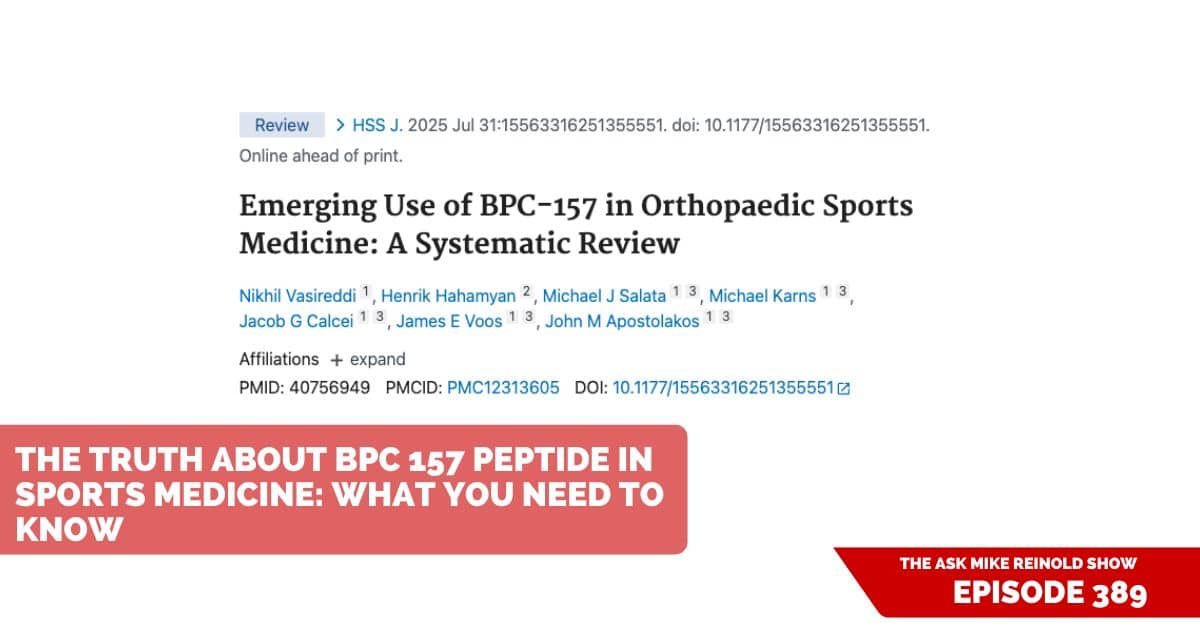
• Emerging Use of BPC-157 in Orthopaedic Sports Medicine: A Systematic Review
Transcript
Mike Reinold:
Welcome back, everybody, to the latest episode of the Ask Mike Reinold Show. We’re here up in Boston, Champion PT and Performance, answering your questions on some episodes and reviewing journal articles like we’re doing on this one. So, what do we have? Diwesh Poudyal, Anthony Videtto, Brendan Gates, Lenny Macrina, Dave Tilley here with a new article to review, which I think is going to be hot. I mean, when you start seeing topics in Men’s Health, and then Self Magazine, and Apple News is sending me updates on these things, on the Wolverine peptide. Is that what they’re calling this thing?
You start seeing it, but we’re looking at a new systematic review on the emerging use of BPC-157 in orthopedic sports medicine. I think, as a sports medicine person, if you haven’t yet been getting questions from people about peptides and BPC-157 in general, you’re probably going to, because they are hot right now in the influencer world. They’re hot online, that sort of thing. Gosh, I think we might have just recently, in the last hours from recording this episode, have some updates to the USA FDA regulations on peptides that are going to be in the future, so I think we’re going to see this more. But Lenny, for the review, what do you got? Tell us about this article on BPC-157.
Lenny Macrina:
Yeah, I will definitely. It’s been a hot topic in my practice, so it was good to read this article, and it kind of reinforced what I’ve been saying, which is we don’t know. This article came out of the Hospital for Special Surgery Journal. It’s titled “Emerging Use of BPC-157 in Orthopedic Sports Medicine: A Systematic Review.” I happened to stumble upon this by Dan Lorenz on Twitter. Again, him and I are the last two PTs talking on Twitter. If you watched that episode a week or two ago, we talked about this. This is by Vasireddi et al., so there’s a bunch of different authors. They just looked at… It’s a systematic review, so they just pulled all the papers that they could find up until 2024, and they specifically said that this is very scoping.
This is about everything that they could find in all the studies. They found what, 544 studies? They narrowed it down to 36 total studies. 35 are preclinical, and one is on a human trial, and so it was very limited in human research, so we got a lot of rats and dogs that were utilized for these studies. Just a side note, BPC-157 stands for Body Protection Compound. That’s simply what BPC stands for. The 15 of the 157 is because it’s a pentadeca peptide. There’s 15 amino acids, and the 7 just kind of delineates it from the other 15 amino acid compounds that are out there. I thought that was a little interesting thing that I learned. I don’t even know if that was in this article. I think it was just my own…
Dave Tilley:
Googling?
Lenny Macrina:
Yeah, exactly. But they wanted to evaluate the mechanism effects and clinical relevance of BPC-157 in orthopedic and sports medicine, which is what we do, and most of the listeners are doing as well. So you get these questions… What is the research telling us? The key findings of the 36 studies was the mechanism of action is angiogenesis, so blood flow, creating new blood flow to an area, collagen synthesis, anti-inflammatory effects, and neuroprotection. So, if you have a nerve issue, there’s been some studies in animals that have shown that the nerve can regenerate faster. Improved tendon health or ligament health. You get some studies that were done on rats that injured their MCL, and they healed faster. They got stronger faster than a group that did not have BPC-157 utilized. It reduces fibrosis in muscles and enhances bony healing and, as I mentioned, nerve regeneration as well.
Obviously, there’s major limitations to this. There’s very few, if not only one, human trial that was a retrospective study, looking at knee pain, and they injected people with BPC-157. They looked at their knee subjective pain, and pain decreased in those that had BPC-157, more so than the people that did not have the injection. There’s only one phase one trial that’s registered right now, and it’s been registered since 2016, and nothing has been updated on that registration, so that tells you something as well. Again, evidence is primarily animal-based, not FDA approved. It’s often sourced from unregulated suppliers. So, you may think you’re injecting yourself with BPC-157, and it probably is somewhat that, but you also could be getting other stuff, so be careful what you’re getting. We did have somebody, that we know personally, that thought he was improving his healing and injected himself with BPC-157, and he failed a drug test for pro baseball and got suspended for 81 games.
Mike Reinold:
That’s what they always say. They always say it.
Lenny Macrina:
Right. It’s banned by water contamination, dosing inconsistencies, unknown long-term effects have all been mentioned in this paper. So, in conclusion, there’s promising biological effects. You know what I mean? There is something out there. There’s insufficient human evidence. Are we recommending it as sports medicine practitioners? I am personally not. I’m not telling people to go get it, but I say, do your research and talk to your doctor or whoever else is going to do this, and personally decide if this is for you, but I am not personally recommending it. I will say, Mike, that you did talk about earlier that it’s in Men’s Health and all that.
Usually, or oftentimes, not usually… Oftentimes, the fitness bros are promoting this earlier than what we know in normal life, meaning creatine was utilized for decades, and now it’s accepted in the general population, and very well studied and very safe, we think, and actually promoted for anybody and everybody, including helping with neurocognitive type stuff, mental abilities, and older people, so maybe we get there someday with BPC-157, but right now I don’t think it’s ready for primetime, and we need a ton more studies in humans, quality studies. That’s my take on this paper. I like this paper. I thought it was good for us, sports medicine people, to see what’s out there and kind of summarize those 36 articles, and that’s what they do. They kind of hit a bunch of articles and give you an update on what they found, but very general, very vague.
Mike Reinold:
I like to think of myself as an early adopter. If Apple comes out with a new product, I want to buy it first. But with this, I tend to take a little step back. I think a lot of people are trying this. A lot of people are doing this, and gosh, the placebo effect is definitely part of it, but it’s also real. I also know people that are taking oral versions of this and I think that science has shown that that’s completely useless. It doesn’t get out of your gut. It actually might be good for your gut, but it’s not good for your patellar tendinopathy, but then a lot of those people say, “No, I feel a lot better,” because they were taking it for two months, and maybe just over the two months of rehab and stuff, they got better. It’s shortsighted to say this isn’t exciting.
I think we’re all excited about the benefits of these things in the future, but gosh, I mean, the concept of the fact that you don’t even know what you’re buying and you’re just getting this from a compound pharmacy with no regulation and no oversight, that’s the scariest thing, because you’re injecting this into your body. It’s not a pill. You know what I mean? You’re injecting this in your body, so that’s the biggest thing for me. Don’t forget too, pro athletes, college athletes, this is banned. It’s not just not FDA approved. This is banned. So, this isn’t even a conversation you can be having with most of your athletes that are coming into this. That being said, I don’t know, anybody have any tales, any anecdotal, any thoughts, or just even where they want to see this go? What can we do in our profession to get better at this? Dave, what do you think?
Dave Tilley:
Yeah. I think with all these new modalities, this happened with dry needling and then BFR too had its thing, is it starts to get really popular and you hear a lot of buds around the mechanismic studies, but at the end of the day, the first thing that we have to take care of is safety. It’s like, what are the adverse effects? Is it safe? I was kind of laughing to myself, but it says, “In the safety profile, three studies assess the safety profile. All three studies assess several organ-specific outcome measures in animal and in vitro models and reported no acute toxicity across several organ systems.” Awesome. I’m happy my liver’s not going to fail, but what about the safety and the efficacy around the orthopedic side of what we’re injecting, the sites, the tissues? I just think that is always in my mind of like, “Is this safe for someone to do, and is this going to have any long-term effects?”
To Lenny’s point, there’s one study in PFJ, like 7 of 12 patients reported subjective improvement in 6 months. It’s like a lot of other things can be going on why somebody has objective improvement in 6 months. Maybe they just stopped doing what hurt them, because it hurt, and they got better. I think I remember needling… This was a big thing, because I took that course really early, and I remember talking about with Sue, actually, about what are all the other important safety factors I have to think about before I even suggest this to somebody as an option? And I don’t know, we work with a lot of surgeons, we work with a lot of really important people, and say someone’s not competing, but if something goes wrong, and it comes back that you recommended or you were like, “Yeah, try these injectable peptides that are not FDA regulated,” and something goes wrong with the surgery or whatever they have, I just don’t want that heat. There’s so many other things we know that are really good, evidence-based things that I want to go with first before we start poking ourselves.
Mike Reinold:
Yeah, no. Totally agree with that. I would say the good part though, correct me if I’m wrong, is there’s no safety reasons. The safety issues are still the unknown, versus so far the safety looks to be good, right? So, at least it’s positive with that. I think that’s like a good part. To your point, Dave, I see this as something else where there’s actually people that are experts in this and experts at testing the body for this and maybe even monitoring your reactions and stuff. I mean, this becomes medical to me. So, I think this is like somebody you outsource this to. You collaborate with them and say like, “If you want to dabble with this, you got to go to somebody that’s an expert in this.”
Lenny Macrina:
Yeah. It was interesting towards the end, the side effects. There are no human trials, so we don’t know side effects.
Mike Reinold:
Exactly.
Lenny Macrina:
They did talk about HGH and EPO as similar peptides and their side effects, but then the authors went online, and they looked at what people reported anonymously on websites and stuff like that.
Mike Reinold:
In Reddit forum evidence.
Lenny Macrina:
Right, and they talk about swelling, joint pain, anxiety, panic attacks, heart palpitations, insomnia, drowsiness, weakness, fatigue, loss of appetite, depression, anhedonia. Again, and they attribute it to “the compound is not pure” potentially because it’s not regulated, so who knows what you’re injecting yourself with, and/or you just freak out because you injected yourself with a compound that you don’t really fully trust, so it’s a lot of mental components as well. Yeah.
Mike Reinold:
That sounds like general counsel wrote that for a pharmaceutical company.
Lenny Macrina:
Exactly. Yeah.
Mike Reinold:
You know what I mean? It’s funny. This is why, let’s say, Ozempic, as just an example… Ozempic, it’s a peptide. It’s like the concept of Ozempic is there, but the difference is that it’s studied, there’s safety profiles, there’s FDA regulations, and stuff like that. You know why BPC-157 doesn’t have it? I hate to say this. Because a pharmaceutical company can’t monetize it because there’s no patent on it, so I don’t know when we’re ever going to get the real truth on this thing, because nobody’s putting billions of dollars into researching it, because nobody’s going to monetize it.
So, it’s still like, I hate to say, a dark market kind of thing or black market kind of thing, but that’s kind of like what it seems like right now. These compound pharmacies, if you want to be successful and get people to do it, maybe they lace it with something, like a little booster thing or a little something like that. We talked about that baseball player. The stories are so common, that I jest a little bit when we say that’s what everybody says. But yeah, I mean, you hear that all the time that people inject something, and there was more in it than they thought. So, interesting, but Brendan, what do you think?
Brendan Gates:
Yeah. It was my turn to get kicked out of the chat room, so I hope I’m not repeating what Dave was saying, because I missed all of that, but I think this is really interesting, and I think, just like all of you guys get this question a lot, especially within the last year or so, and like you said, people are taking this. Even if there aren’t human trials, a lot of people are taking it, and it’s very seemingly easy to get. It was cool to read a little bit more about it.
But one, I dream of the day where after surgery, outside of just getting a nerve block and a couple days of painkillers, they prescribe the essential amino acids. We’ve talked with some surgeons, protein, creatine, and then maybe they prescribe BPC-157 when we have more data on it, and it helps to attenuate atrophy and jump-starts the rehab process, so I think that’s really exciting to me. I think that’s low-hanging fruit that we could really get better at, in terms of rehab. I also don’t think it’s there yet. Did we talk about the angiogenesis thing and some of the downsides to it?
Lenny Macrina:
We touched upon that it’s a byproduct, it’s a result of the injection, but we didn’t talk about anything else.
Brendan Gates:
Okay, so I guess what I wanted to bring up, and tell me if I’m wrong… This is certainly not something that I talk about every day, but my understanding is that the BPC-157 increases the VEGF, which then helps with producing angiogenesis, which is essentially building new blood vessels, right? It makes sense from like a rehab standpoint, it’s probably why it’s effective, maybe, but it’s also the same biological pathway that makes tumors grow, and that is a little concerning to me. And so, it’s not that angiogenesis is bad from BPC-157, but it does raise a little concern to me about unwanted cell growth from this as a byproduct. So yeah, maybe it seems to help a lot of our orthopedic injuries, but also, if it’s helping tissue grow, is it helping unwanted tissue grow that maybe we don’t know about? That’s really one that I don’t know if that’s true, but it’s a big concern in the back of my mind every time someone asks me about that.
Mike Reinold:
Yeah. I mean, there’s peptides that stimulate HGH, pituitary gland function, and stuff like that. I mean, there’s some real concerns about some of these concepts. Not that it would give you cancer. I think that the safety profiles are showing that, but again, God forbid you have something growing that you don’t know about yet, and you stimulate that, that would stink. I think that’s like a fear that’s probably going to limit me from doing these sorts of things, but I think, just like everything else, maybe you have a minor injury and you inject it locally for something, that sort of thing. I don’t know.
Maybe there’s some future here on this. I don’t know the answer to this, but I think right now, without having anybody being able to monitor this, I don’t know how we get past just the influencer phase of people recommending this, because I don’t know how we’re going to get there. We need some science out there, but we need some real science, and it’s not just like simple things that somebody’s going to do in a clinical practice. I hate to say I don’t know the future of this, but it’s exciting, but also I don’t know how we’re going to get there. I don’t know how I’m going to feel better about saying that this is something we use.
Lenny Macrina:
Yeah. We Just need a lot more human trials, like phase one, phase two, phase three. We need all that. A little on Brendan’s point about cancer and all that, you are correct, I would imagine. They did also talk about… One study assessed the mutagenicity and teratogenicity of the compound, basically looking at, “do any mutations occur by injecting, or are there any effects of like fetal development?” That one study did not prove that there was any kind of that ill effect occurring from BPC-157, but that doesn’t mean it’s safe. That just means, one, which I didn’t read that one study, but there is one study that talks about mutating your genes, but that’s a little different than what Brendan was talking about, but could cause cancer as well.
Mike Reinold:
All right, so what…
Lenny Macrina:
It’s so early.
Mike Reinold:
What’s our take home? So, if you’re a clinician and you’re faced with this, and you have this here, first, the first thing you understand is you have to understand what it is, because you got to understand that. So, I think read the papers. They are very helpful. Hopefully, this episode kind of like shed some light on it here, and then I think the talking points that you can tell people again is like, this is a banned substance. If you’re an actual athlete, it’s kind of a no-go right there, but then you tell people, from your understanding, here’s what it does, and from your understanding, and here’s some of the potential cons. You say, “If you’re interested in exploring more, I recommend you go reach out to a local person that like, this is what they specialize in,” and by all means, I would find somebody in your community and collaborate with them.
I’d love to see this more, and trust me, there’s tons of people that are willing to take the risk. Great. I mean, great for them. I mean, I want to see the outcome from them. I want to learn from that. Awesome. Thanks, Len. Appreciate that. Check out that article in the show notes so you can be a little bit informed on BPC-157, and we’ll get ahead of the influencers a little bit, but the more we know, the more we can have conversations, I think, with the people that are in front of us that trust us each and every day, so appreciate it. If you’re enjoying these episodes, let us know. Head to mikereinold.com, click on the podcast link, and you can submit questions for future episodes. You can subscribe from there. Whatever you need, we’re here for you guys, so just keep them coming, and we’ll keep answering. We’ll see you on the next episode.