
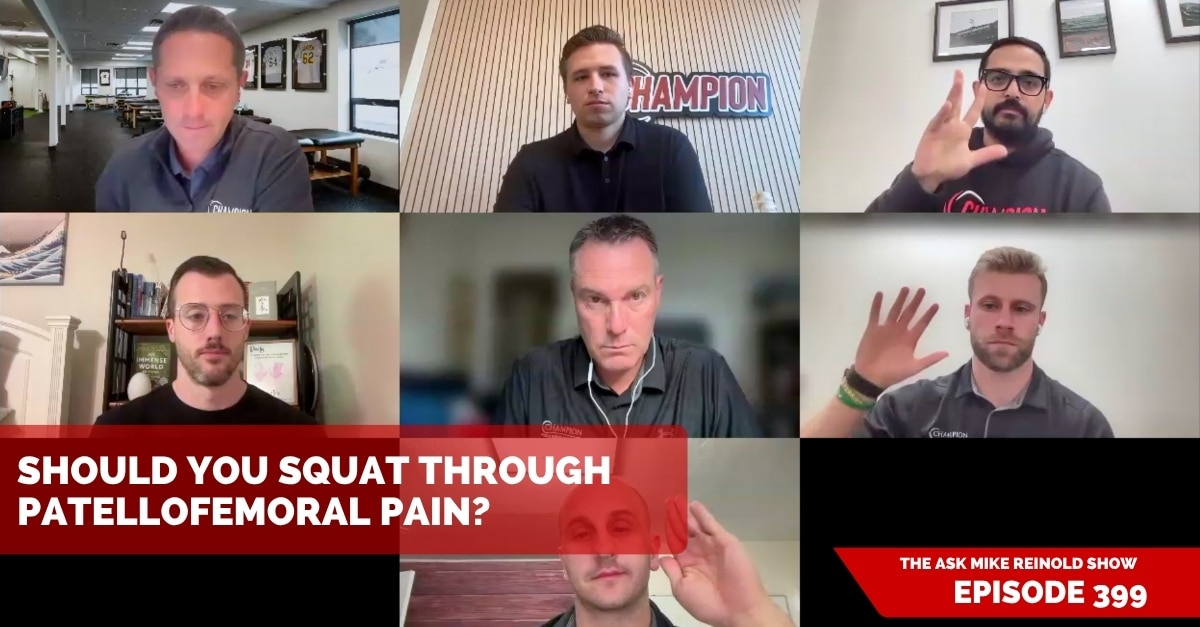

Squatting is one of the first activities that becomes painful in people with patellofemoral pain. It is also one of the first exercises many clinicians remove from the program.
But is avoiding the squat helping the knee, or simply reducing the athlete’s capacity to tolerate it? Somewhere between ignoring pain and eliminating every painful movement is a more useful approach.
In this episode, we discuss how much discomfort may be acceptable, which squat modifications can help, and how to progress loading without constantly provoking the knee. Check out this week’s podcast to hear how we manage painful squatting in active patients.
To view more episodes, subscribe, and ask your questions, go to mikereinold.com/askmikereinold.
#AskMikeReinold Episode 399: Should You Squat Through Patellofemoral Pain?
Listen and Subscribe to Podcast
You can use the player below to listen to the podcast or subscribe. If you are enjoying the podcast, PLEASE click here to leave us a review in iTunes, it will really mean a lot to us. THANKS!
Show Notes
• Online Knee Evaluation and Treatment Course
Transcript
Luke Alfonso:
We got a question from Sarah in Nashville today. She says, “When someone with patellofemoral pain has pain during squats, do you stop all squats, or do you modify? One of the doctors that sends me patients always tells his patients to stop squatting. How do you decide whether to stop squatting or keep loading through some discomfort? I feel like I’m either being too cautious or pushing too aggressively.”
Mike Reinold:
Awesome. Sarah, great question. I like questions like this. I like when PTs send in questions based on weird things doctors say. Sorry, doctors.
Lenny Macrina:
Yeah, I know.
Mike Reinold:
None of you are listening to our podcast. But we should do this…
Lenny Macrina:
We need an episode.
Mike Reinold:
Yeah. “Weird Things Doctors Say.”
Lenny Macrina:
Yeah, yeah.
Mike Reinold:
That wouldn’t go over well.
Lenny Macrina:
Yeah.
Mike Reinold:
But okay. So, somebody has patellofemoral pain, which, again, I don’t want to call patellofemoral pain a junk term, but let’s just call that a broad term. So, this is a knee pain thing. When I hear patellofemoral pain, to me, that means this isn’t a meniscus, an ACL. It probably isn’t even patellar tendonitis, because that has its own name.
So, to me, this is somebody in knee pain, a doctor says, “Oh my gosh, you’re squatting. That’s why. That’s the issue.” And now you got a patient that’s afraid, maybe they’re afraid to squat, because they’re like, “Oh gosh, is that why I’m in this position?” So, you have all these things, and then you have the therapy community and the strength and conditioning community that wants you to do stuff, because we know how important it is.
So, all right, where do we start? Let’s start at the top. Dave, you want to jump in here, just your thoughts on this in general, because I feel like you probably deal with this not just from doctors, but even from coaches and maybe even parents and stuff, too?
Dave Tilley:
Yeah. I think the first thing that… The reason that we’re laughing or making kind of a joke of it is because you always think about, “Well, this person in their daily life, is this person not allowed to ever go to the bathroom again, they can’t sit in their car again?” That’s a bit frustrating sometimes, because they have to squat. There’s no way around that.
And I think the nuance there is squatting as an exercise and squatting for load is probably where we’re getting into this. So, yeah, I think it’s really important that you mentioned first is that patellofemoral pain, even if you take away patella tendonitis, meniscus, all that stuff, there’s still a lot of variance of patellofemoral pain that I think a lot of work from Tim Gabbett and others has shown us that, yes, maybe acutely you want to deload tissue that’s really irritable or cranky, but at some point, load is good.
The right type of load in the right amount is probably good. And even for those with patellofemoral pain, you want to try to load tissue to remodel, on the mechanical side, some of the tissue that’s cranky. And then there’s that aspect, too, which is you want to desensitize some of the stuff, like a fat pad irritation, or maybe it is truly the back of the kneecap and one side’s just irritated. But at some point, you have to actually load the tissue to try to allow it to get used to whatever demands are coming down the way.
And if you have someone who’s in a sport, they want to hike, they have kids at home, and they have to be bending up and down to pick people up, it’s unrealistic to say, “Well, you’re never going to be able to do this, so we should avoid it at all costs,” because it’s pretty much just not going to happen with the reality of life as parents or sporting athletes. So, I think that’s the nuance of it.
I think one thing that’s really important to remember is there’s a lot of ways that we can modify squatting for people. And that’s what I always try to educate people on, is, yes, maybe you got into… I love CrossFit. But the best thing is, someone goes to CrossFit, they learn about stuff. I love CrossFit and lifting, but they learn how to front squat, and clean, as soon as they get there. And it’s like, okay, well, that’s a very challenging type of squat for the knee because of how much force it puts across the shears.
So, it’s one thing to say never squat. It’s another thing to say, “Is there a different version of a squat we can temporarily try to see if it’s more of your hips, less of your knees? Can we do a low-bar box squat when you go to CrossFit, when everybody else is front squatting or cleaning? Or can we stay away from full-depth cleaning? Can you just do power cleans when you’re learning?” And maybe that will help calm things down.
So, there is an entire… And Dan has a really good graphic on his website. It’s literally the most knee-dominant squat you could possibly do, like a slant board squat or a sissy squat, all the way to the most hip-dominant squat you could do, like a low-bar box squat. There’s probably six or seven variations across there that that person just might need a different option for a little while until their knee calms down, and then somebody else can pick up and chat.
But there’s many other reasons why someone’s knee would bug them in patellofemoral issues, with hip stuff or ankle stuff or the way they’re squatting mechanics. So, yeah, I’ll let somebody else jump in there. But I think the type of squat somebody gets, they don’t understand that, “Maybe I just did this because someone told me to.” But they learned from Diwesh or one of our strength coaches, “Here’s nine types of squats. Let’s find one that feels good temporarily.”
Mike Reinold:
Love it. And that’s exactly what I want to hear from Diwesh in a little bit. But before we get to that, let’s talk maybe the biomechanics of this a little bit, and just say… And Kevin… I consider Kevin and Dan right now my PubMeds. They’re my two PubMed geniuses, genii? What’s the plural of geniuses? But they’re so on top of everything.
But I’ll ask you the question, Kevin. So, if you squat to a certain point, does your knee explode? Is there just a point of no return where all of a sudden, bam, you’re down on the ground and you can’t go any further. But why do people even think this is a consideration from a biomechanical perspective?
Kevin Coughlin:
That’s awesome. I wish Dan was here, because I’m sure he’d have a funny response to that question. But yeah. No, I think just the important things to keep in mind, when we’re thinking about the patellofemoral joint, is that if you’re in closed chain, the deeper that you go, I think a lot of the research will say around 45 to 60 degrees and beyond, you get more joint contact between the back of the patella and the groove that it’s sitting in in the femur.
So, with that, as we increase knee flexion in closed chain, that’s going to potentially increase pain for people, because if we’re thinking of the total force going through the patellofemoral joint, it’s going to be a combination of the contact surface area and the force, or the load, that you’re holding with an external load with a weight. So, we have a couple levers we can pull there to reduce the total force. We can reduce the amount of range of motion where we might have less joint contact between the two surfaces, or we can reduce the external load, and that might have an effect on reducing pain.
And then as well, I think the opposite is true in open chain. So, when you’re from 90 degrees of knee flexion up to about 45, you’re usually pretty good. As you get closer to full knee extension, you get more contact there again in the patellofemoral joint. So, you might see on either end of that, when they’re in a deeper range in closed chain, or they’re at the terminal range near lockout and open chain, they’re reporting symptoms.
So, I think Dave’s point makes a ton of sense, is there’s so many different variants and options we can do here to try to reduce the amount of load going through the patellofemoral joint, that maybe we can keep squatting the same exact variation they like to do, but we reduce their range of motion. Or one thing I know that Dan will do a lot with his lifters is, if we have to back off total load and range of motion, let’s just increase a tempo and make it more challenging. And I know Diwesh, he sees this a lot in the gym and will have good recommendations on how to modify, but I think those concepts are important.
The other thing I’ll say is that in the patellofemoral joint kind of research, you do see cases to be made for doing… McConnell taping can be helpful. So, whether it’s something like that or adding an insert in your shoe could be helpful. And that gets confusing for people, because you’ll then turn that into, “If you’re too pronated, or if you have a weak VMO, or your patella is maltracking, you’re at increased risk of patellofemoral pain.” But it actually seems like once you’ve developed it, working on those things seems to be helpful. So, it might not be something that is prognostic, like you’re going to end up developing this, but it can help reduce symptoms.
So, we do know that if you’re having a lot of valgus in your knee when you’re squatting, whether you have a very flat foot posture or something like that, and the patellofemoral joint is already sensitized, that changing the position of your foot can probably change the contact area in the patellofemoral joint, and that might reduce symptoms as well. So, I think those are important concepts to keep in mind, too. It’s not just things that are happening in the sagittal plane. There’s probably some influence in the frontal plane and the transverse plane, and playing around with foot posture once you’re sensitized can be helpful. So, that’s another thing, I think, biomechanically, just to keep in mind.
Mike Reinold:
Yeah. And this goes back to the… We talk about this a lot all the time, but there’s this movement online sometimes where, “There’s no such thing as a bad squat.” And maybe that’s true. I don’t even know if I even want to agree with that, to be honest with you, but there is such a thing as a better squat and a worse squat. So, you can change things. If you squat in a certain position, it’s going to change patellofemoral contact forces, and it’s going to probably decrease your ability to have a proper output. So, it’s not even going to be beneficial for it.
So, I love that. I think that’s an important part. And the thing that blows my mind biomechanically here, too, is if you actually think about patellofemoral compression forces, even tibiofemoral, there are so many things that are probably more stressful than doing a squat, like running and jumping and stuff like that, that could be even worse. But for some reason, those aren’t as shunned by the physicians as much.
All right, Diwesh. Okay, so we know you aren’t going to fall to the floor and crumble to the ground if you do a squat. We know that. Dave said it very, very well. Tissue loading is important, but we probably need to modify.
So, Diwesh, you probably deal with people with some knee pain every day that doesn’t even warrant them coming in to us to see us on the physical therapy side. How do you help get them through? How do you regress them? What are some of your tips for physical therapists? Because this is the great opportunity where we learn from our expert strength coaches and become better physical therapists.
Diwesh Poudyal:
Yeah. So, our big philosophy is we don’t want to make the biggest change right away. We just want to start to make small tweaks to either form in how we execute that movement, and changing the lever lengths at the knee joint versus at the hip joint, and see if that simple cue, or that correction, or a slight modification within a stance is going to make a difference.
So, a good example is if, let’s say, we have a beginner, they’re starting with a goblet squat, because it’s a good entry-level exercise to get someone squatting with really good form. But because that load is out in front, your torso is a little bit more upright, shin is going to travel forward, you’re going to have a little bit more anterior knee stress. So, we went in with good intention, but let’s say, in that scenario, that a person is experiencing a little bit of knee pain and they’ve already had a prior history.
So, my immediate regression isn’t going to be all of a sudden like, “Hey, let’s just go body weight and see how that works.” I can simply just pull the weight in a little bit closer to me, set my hips back a little bit more, maybe even push my knees out a little bit more, or even go slightly wider stance. So, similar to what Kevin was kind of finishing off with, is we can make this movement either a little bit more hip-dominant, or we can open up through the hips and groin a little bit more to create a little bit more frontal plane stress and have a little bit less sagittal plane anterior knee stress.
So, we would start with something like that as the initial entry point. Can we make a small change with how they’re performing the movement, and can we bring that pain down from, let’s say, a five or a six out of 10 to maybe a one or a two out of 10? Because if it’s one or a two, and it’s staying a one or a two throughout the entire 10 reps that they’re doing, and it’s still a one or a two on set number two, on set number three, set number four, it’s probably okay. So, part of the tissue adaptation concept that Dave was talking about is that we do need to strain and stress the tissue a little bit. So, a little bit of that strain is fine.
Now, if that slight modification doesn’t work, we do have to change and make maybe a little bit more of a bigger change within the exercise. And this is where we do go into our variations of squatting and start to modify there. So, similar to what Dave was saying early on, is we know the spectrum that exists, from the most hip-dominant, that has the least amount of forward knee translation on a squat, to the most amount of knee translation.
So, if we need to go down that path, we can go down into a low-bar back squat where you’re really sitting back into your hips, that almost looks like a deadlift, and maybe you’re even limiting depth by going to a box, or you’re just saying, “Hey, don’t go as low.” So, now we just took that stress and put it mainly on the hip joint, but still have some level of knee joint stress so we can create a little bit of that adaptation, and we’ll see how long the client can tolerate that or even progress on that exercise.
And then maybe we start adding in a little bit more knee stress by going into a slightly higher bar position, let’s say, just a regular back squat, where the torso is still pitched forward a little bit, and it’s just a little bit less stress on the hip and a little bit more stress on the knee.
And then we just keep going down that path until hopefully we make that adaptation, and then eventually we might be able to handle whatever kind of squat. And maybe we’re doing front squats that are full depth, and knee translating forward, and all that stuff, and they no longer have pain because we’ve taken the time to make them adapt, and they should be good and ready to squat whatever variation, hopefully.
So, that’s kind of the way that we progress, is start with the small little changes, and then, if needed, we’ll make the bigger changes and swap exercise types or variations entirely if we need to.
Mike Reinold:
Awesome. Yeah, love it. Great episode, guys. Sarah, hopefully that helps. I think the answer is always going to be modify before stop. I think we’re always going to say that on almost anything, but there’s an intelligent way to do that as well. So, hopefully we gave you some good tips that you can handle that. Good luck with your physician, but sometimes it is what it is. You can try your hardest. But remember, there’s other things you can do other than squatting that can still help them as well. And Diwesh kind of brought up some really good concepts on how to handle that.
So, another great episode. Thank you so much, Sarah, for submitting your question. If you have anything like that, head to mikereinold.com, click on that podcast link and fill out the form, and subscribe on Spotify, Apple Podcasts, or wherever the heck you listen these days, and we will keep doing these episodes. We’ll see you on the next episode.