

Seeing more patients can provide valuable clinical experience. It can also leave a young therapist rushing through examinations, repeating generic treatments, and completing documentation long after the clinic closes.
That makes “How many patients do you see?” an incomplete question. Visit complexity, double-booking, support staff, documentation expectations, mentorship, and control over the schedule all influence whether a caseload is sustainable.
In this episode, we discuss how new graduates should evaluate a job offer and how owners can balance productivity with patient care and staff development. Check out this week’s podcast for the warning signs both clinicians and employers should recognize.
To view more episodes, subscribe, and ask your questions, go to mikereinold.com/askmikereinold.
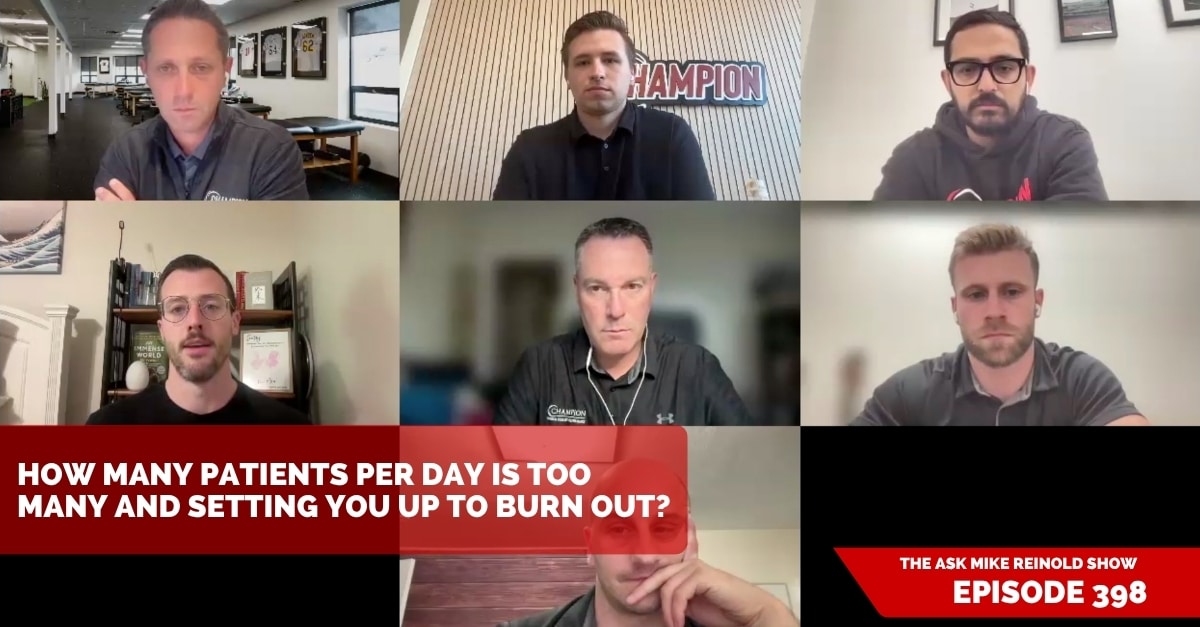
#AskMikeReinold Episode 398: How Many Patients Per Day Is Too Many and Setting You Up to Burn Out?
Listen and Subscribe to Podcast
You can use the player below to listen to the podcast or subscribe. If you are enjoying the podcast, PLEASE click here to leave us a review in iTunes, it will really mean a lot to us. THANKS!
Show Notes
Transcript
Luke Alfonso:
I got a question from Rachel from Atlanta. She says, “I’m interviewing for my first job, and one clinic expects therapists to see 16 to 20 patients a day. They say that’s normal, and that I’ll learn faster because I’ll see more cases. At what point does a high caseload become bad for the therapist and the patient?”
Mike Reinold:
Awesome. Rachel, man, that is probably, gosh, I’d hate to say the number one question because we do get a lot of questions, but in terms of questions that I think the current state of physical therapy… Students and new grads or even early career professionals are asking us this exact question. And it’s funny, Lenny, and I guess we date ourselves. We’re like, wow, 16 a day. That sounds like a breeze.
Lenny Macrina:
That was a morning. That was a morning.
Mike Reinold:
But I think when we’ve been talking to our PT students lately, and you guys, the PTs, everybody here takes students. I think this is the number one thing that they’re thinking about and they’re asking about. You can tell Rachel asked that in her interview, how many they see. And yeah, I think she phrased this really well. She phrased it on the pessimistic side, which is okay. When does it become bad for both her and the patient, which is a very valid question. But I think their employer phrased it from the optimistic side, that it’ll be beneficial for her to get some experience and stuff.
So gosh, I wonder where the fine line exists. So Len, do you want to start off with a historical perspective? That’s what we can say. What are your thoughts as an old person? Sorry. And then I’d love to hear from Kevin and Brendan just what their current thoughts are as middle-career professionals. I know you guys probably were facing that, but Len, why don’t you kick it off? What do you think?
Lenny Macrina:
Back when I was treating King Tut, he was difficult. Honestly, I’m not even exaggerating. That was our morning. We would treat 30 to 40 sometimes in a day. And trust me, it was not easy. But I got my notes done, and I felt like I gave really good care. I never felt like it was bad care. I had a good helper. My athletic trainers were all… They knew me, they knew our systems, and we just went at it. And the notes got done. Everything was electronic, like a tablet or a laptop thing that we got, and we got it done.
Now I get it. It’s not for everybody. And I thrived in it, and I still do to this day. I catch my eyes wandering because now we’re one-on-one. So my mind is just like, I’m looking for others. I’m looking at other stuff. Because the one-on-one is great. Trust me, my patients and I, we have a blast, but I’m used to the fast four, six, eight at a time going. And I know it’s not ideal. And it’s probably… There’s a legality side of it too that I think is where there’s a gray area.
But it’s not for everybody, and you got to figure out, are you going to last six months, a year, two years? I did it for 12. And it was only because we opened up in Boston, Champion, that I left. Otherwise, I’d probably still be grinding doing that. And I had a great time. So it’s not for everybody. I think my personality was okay with it. I handled that fast-paced, and I just learned a ton. And we had great doctors. I had access to the doctors, and I made sure that I carved that out as part of my career, was to get to the doctors and be able to talk to them as much as I could. And I used that to be able to speak.
So I think it was that and the patient experiences that got me to where I was able to get to do national speaking and to write papers and to publish research. So it’s all what you want to make of it. And if you find yourself getting, I guess, burnt out or tired from it, then you move on. But I think if you are considering it still, you take the 16 to 20 a day, and you take the experiences, and you’re going to have a huge amount of mental experiences that you can tap into when you’re off on your own, and you have a good practice going on your own somewhere, hopefully locally, where all those patients will want to see you. And now you have a good base of patients to start with when you have your own experiences and you’re on your own. So I hope that makes sense. You’re building that mental database of experiences that’s going to be huge for you when you’re two, three, five, 10 years out, 20 years out like us.
Mike Reinold:
Yeah. And to make sure people understand what Lenny’s saying here too, he mentioned we had partners in that system. So it was basically two clinicians treating that many people. So if you actually divide it by half, it’s not astronomical, like crazy to think about. It’s just two people working together and knocking it out, which I don’t think that model’s as popular as it used to be either. But man, a PT and a PTA or an athletic trainer, depending on the state you’re in, tackling a schedule together. I mean, you could make a lot of damage that way because there’s some downtime between things. There’s times for you to hop back and forth between people. It’s not necessarily the right thing.
But gosh, Lenny said something that I think is the most important thing to take out of this. For you to become good at anything in the world, it’s about repetitions. So I think this is the first thing I’m going to say. If you work in a place that sees 16 patients a day versus a place that sees eight patients a day, I can almost guarantee you’ll get twice as good at your profession in half the time. It’s just math. It’s just the way it works. You won’t be stumped when somebody comes in because you’ve seen it a few times already earlier in your career. So I think that’s some of the benefits type things.
From the employer, the other thing I would just tell you guys too, the new grads and stuff here, it depends on where you are. If you’re in New York City, gosh, the rent’s expensive. So employers aren’t doing this because they want to get rich off you. They’re doing it because that’s the model that they need to do to make their clinic successful. So keep that in mind too. It’s not always a greed thing. Sometimes it’s a location thing. So if you choose to work in Manhattan or you choose to work in Downtown Chicago, that might change things. So it also goes back down to your preference in where do you want to live. But Kevin, Brendan, I’d love to hear from one of you guys who wants to start off. Maybe Kev, what do you think about this concept from your perspective?
Kevin Coughlin:
Yeah, I think what I would wonder about with the clinician asking is what other benefits does the company you’re working for offer you? Is everything else really good, but you’re a little overwhelmed with the number of patient visits? Because sometimes you got to do that kind of calculus on your own. If you’re an early career professional, you’re not always going to get everything you want in one job, and there might have to be some sacrifices. So if your dream scenario is treating eight to 10 people a day, but you want good continuing education and good mentorship from your coworkers and time to do documentation during the workday, and you have all those other things lined up, but it’s just the patient visits, sometimes there is some give and take there, and you have to be willing to sacrifice on that.
The other thing I’d say, and I think Lenny mentioned this, is in terms of the burnout specifically, I think some people’s personalities can just handle it really well. They do well in a high-stress environment or they do well with a lot of things going on. Some people don’t. And if you’re going to be the clinician who’s always thinking that the grass is greener somewhere else and that you can’t stop fixating on the fact that, “Oh, I think my boss is trying to get rich off me, the whole system, the healthcare system stinks, I’m seeing too many people.” If you’re just kind of ruminating on that, you either have to change your mindset or look for a different position, I think.
So it’s probably not for everybody. But I think if you’re in that environment, you can make the most of it because I think what both of you said is so true. The more repetitions you get early on, even if you know this is only a five to 10-year plan, and then you want to go somewhere with a lower patient caseload, that’s totally fine. And then you have all those repetitions you built up early on.
So it’s one of those things. I don’t think there’s a right or wrong answer. It really depends on how you look at it and what else you’re getting out of the job and what your long-term goal is. But I do think for a lot of people, it’s probably a good thing in the long term. If you can look for the benefits in it, there’s probably some there.
Mike Reinold:
Yeah. And you got to be happy. And I think in our profession, the majority of our profession… Look, we’re not the highest paid profession. Everybody knows that going in. You can make more money in a different profession. But I think the satisfaction level, and do people enjoy their job, do they enjoy going to work every day, is very high in our profession, hopefully because you chose it based on your personality. So if you’re in a position where you just can’t stand your job, it’s not matching your personality, I agree with Kevin 100%. You got to move because life’s too short. So find an environment that’s good for you, and I think that’d be huge. But Brendan, what do you think? What are your thoughts?
Brendan Gates:
Yeah, I think I see both sides of the question. For the employer to say that you’ll learn a lot faster because you’ll see more cases, I totally agree. And I think at one point I was the PT worried about having too high of a caseload in my first job out of school. But I took it. I was in a higher volume clinic at first, and it felt super overwhelming. And I felt a little guilty sometimes because I felt like I was almost learning through trial and error a little bit with some people that I wasn’t as comfortable with.
But now, looking back on that, I would not trade that first job. I thought it was super valuable to get me to where I am now in a lower-volume clinic in our one-on-one care. It’s closer to maybe six to eight people a day rather than 16 to 20. But I think that there is value to having the high-volume clinic right out of school and getting those reps, like you guys have said.
I certainly think that we need to keep patient care a priority. And if that starts to drop based on the personality, if you’re overwhelmed, you can’t program or prep as much as you want to, then it might be worth looking to a place that has maybe 40-minute treatments rather than 30 or something like that. There is, I think, a sweet spot between what we do and the really high-volume clinics. And I think part of that is based on the clinician.
I do think another valuable thing that I know you’ve talked about, Mike, is the higher volume places, they force you to develop a system so that you can really streamline things and your way of thinking and reasoning. So I almost think that getting tossed in and figuring out as you go can be really valuable for a lot of people. So I definitely think there’s a sweet spot, but I think there’s value to a higher volume clinic.
Mike Reinold:
Yeah, love it. I mean, that makes sense. To me, I think I’ll end the episode with this. I’m going to hit this question from a different perspective, I think is, okay, you’re in that situation. What is some advice I would give you to handle that situation as best as you can? Because you’re right, there are some hesitations.
But I will say when some of our students say, “Hey, my first job’s going to be one-on-one,” and they have two, three, four patients a day for a while, I don’t think that’s ideal for them. I would rather you be on the other side of that, to be honest with you. You’re going to have a hard time getting your reps in. And like Brendan said, sometimes you feel like you’re experimenting on people, and sometimes that’s real, and oftentimes it isn’t. It’s just your lack of self-confidence because you don’t have the reps, but you’re well prepared for it.
But I’m going to give you the answer to this as advice. And the first one for me was definitely going to be systems, like Brendan said. You get really good at systems. Luke and I talked about this yesterday in the clinic, systems. So we’re going to do almost like an a la carte of a few different micro recipes that you put together, so that way you know it’s in sync. So systems is number one.
Two is if you can change your schedule, I would book people every 30 minutes, not two people at the top of the hour if you can, if you have to treat 16 people. This is the advice. We talk about this a lot in my CPS program in our community because people are trying to implement this. Every 30 minutes, you can do a bunch of hands-on stuff and then give them some guided TherRex-based things that you can monitor while you’re working on the next person, and it’s a good community environment.
The third one on that is based on schedules. I would actually say my biggest advice is, if you can control your schedule, control it. Meaning do not let a front desk person schedule on your schedule for you. There’s nothing more disruptive than putting an ACL post-op evaluation in the middle of two complicated patients that need your hands-on and time. You know your patients better than anybody else, so try to control your schedule as best as you can. Even if you send the people out and tell them to go schedule at the front desk at specific times, make sure that you are putting the right people at the right time. And that caseload gets a lot easier.
I say this with Lenny all the time. It would be so disruptive for me to have six Tommy Johns in a row and then throw an ACL in the middle of that. That would just destroy the flow of my day, even though that sounds cool. Well, you put that on yourself, Len. But that’s my biggest one.
And then the last one, and I say this to everybody, is I do all my notes before I go to work. I’m fresh, I got a cup of coffee. It takes me 10, 15 minutes to bust through all my notes. And I go into that day prepared. I know exactly what I’m going to do with everybody. And sure, at the end of the day, you tweak a couple of things, but you go in there prepared and ready to attack the day. It doesn’t matter how many people. Again, Luke and I, we do this every day I’m in. I send him a list of the game plan for the day.
So for me, that’s my biggest piece of advice because sometimes you can’t control this, so how do we make it as best as possible? Rachel, I think that’s a question a lot of people are going to have, so thank you for submitting that. If you have a question like that, head to mikereinold.com, click on that podcast link, and ask away. And thank you so much. We will see you on the next episode.