

If you treat a lot of knee pain, this week’s episode is for you.
We review a new best-practice guide for patellofemoral pain that pulls together research, patient voices, and expert reasoning into one playbook. But here’s the twist: when you blend the data with what patients actually want and what clinicians really do, one deceptively simple priority rises to the top – something many of us already use, but probably not the way this paper suggests.
I know we are changing what we do at Champion. Curious what it is and how to sequence everything else around it? Check out this week’s podcast episode.
To view more episodes, subscribe, and ask your questions, go to mikereinold.com/askmikereinold.
#AskMikeReinold Episode 375: Practice Guidelines for Patellofemoral Pain
Listen and Subscribe to Podcast
You can use the player below to listen to the podcast or subscribe. If you are enjoying the podcast, PLEASE click here to leave us a review in iTunes, it will really mean a lot to us. THANKS!
Show Notes
• Evaluation and Treatment of the Knee
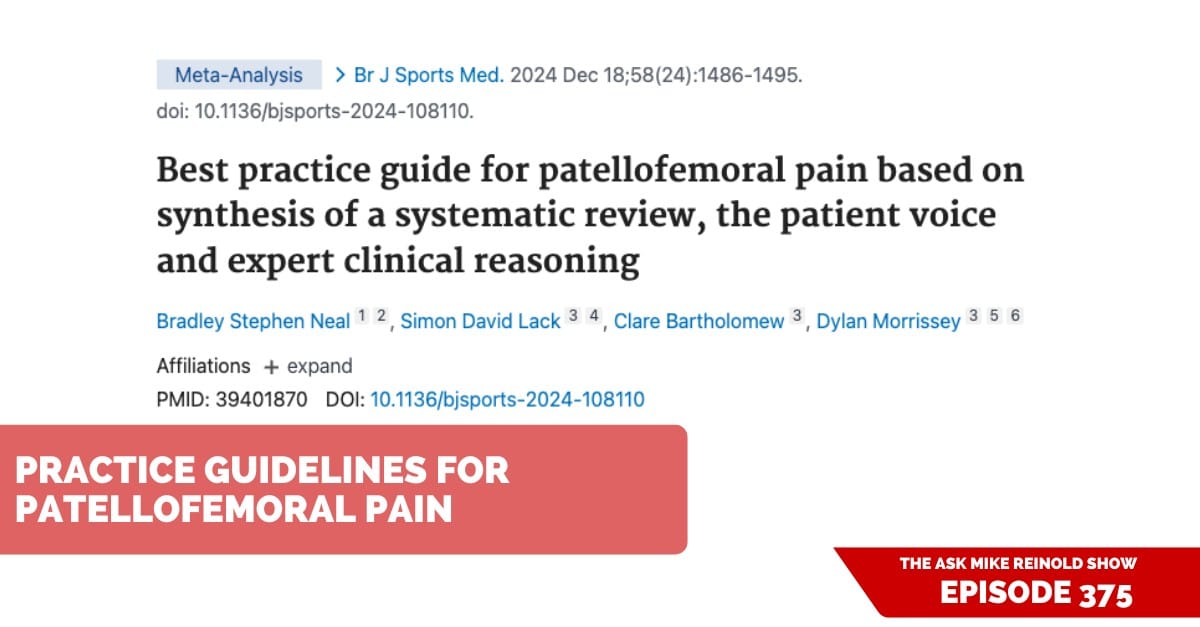
• Best practice guide for patellofemoral pain based on synthesis of a systematic review, the patient voice and expert clinical reasoning
Transcript
Mike Reinold:
Welcome back everybody to the latest episode of The Ask Mike Reinold Show. We are here up in Boston at Champion PT and Performance. We’re here for another episode with a journal article review. We got a good one today. I’m here with Lenny Macrina, Dan Pope, Kevin Coughlin, and Anthony Videtto. And in today’s article, which is a cool article I think everybody at Champion has read… Well, obviously everybody on this podcast has, but I think we were even talking a little bit beforehand about new practice guidelines for patellofemoral pain, which is always good to see. It’s always good to see these updates. I feel like a new one of these comes out every now and then, so we’re going to talk about this latest one. Brendan, take it away.
Brendan Gates:
All right, guys. So here’s a very short title. This is a Best Practice Guide for Patellofemoral Pain Based on Synthesis of a Systematic Review, the Patient Voice, and Expert Clinical Reasoning. So this was published in the British Journal of Sports Medicine in 2024 by Neal and colleagues, and their aim was to develop a best practice guide for patellofemoral pain that blends systematic review evidence, patient perspectives, and expert clinical reasoning, which I thought was interesting.
Their methods were a mixed-method synthesis. So this essentially meant they had four sources of evidence. They did a systematic review with a meta-analysis that included 65 high-quality randomized control trials with the subject participant number being just under 3,800. They conducted patient interviews with people who had patellofemoral pain. They did 12 interviews here. They also did expert clinician interviews with 19 expert clinicians who had over five years of experience working with patients who had patellofemoral pain.
And then lastly, they held three focus groups that lasted about 90-ish minutes with expert clinicians discussing some of the findings through the other sources of evidence. And the goal was to essentially integrate these findings from these four sources of evidence into a clinical decision framework that highlighted both evidence and practical reasoning. So what did they find? Essentially, they discussed 13 interventions through the four sources of evidence, and they ranked them. So they had primary efficacy, which is essentially the most recommended based on these findings. They had secondary conditional, and then they had some interventions that they listed as not effective.
So the most recommended intervention for patellofemoral pain was knee-targeted exercise. That was followed by hip and knee combined targeted exercise, prefabricated foot orthoses, and manual therapy. Secondary, they listed movement retraining, taping like McConnell taping. And it was interesting. This was advocated by patients and experts, but there was weaker trial evidence from the systematic review.
And then they found that dry needling, vibration therapy, hyaluronic acid injections, these were all actually listed as not effective per this study. Through these interviews, there were a couple themes that became clear through the patient interviews, so talking to the people who had lived through patellofemoral pain. They seemed to voice that they valued a clear diagnosis to try to figure out what’s going on. They valued a tailored plan of care to their specific situation, and then they also valued patient education.
For the expert themes that were discussed through the interviews and the focus groups, they found that it was important to have a thorough assessment performed with your patient, then to prioritize active rehab, and then layer in some of the adjunct therapy that they list in this paper. So the clinical implications and what can we take from this? I guess essentially the take-home was the best practice for patellofemoral pain is a mix of knee-targeted exercise plus patient education as a foundation, and then to layer in some of these other adjunct therapies.
Sounds like it’s important to start with a thorough assessment, figure out the population of your patient, the goals, the symptom history, their impairments, and then figuring out essentially what is the best entry to exercise for knee and then hip and knee combined strengthening. They also talked about, again, avoiding wasting time and resources on interventions that they say don’t work. So I think that’s interesting. I’ve certainly used things like dry needling as a way to get pain relief for people with this. And maybe I need to rethink that, but I’m interested to hear what you guys think.
Mike Reinold:
Awesome. Great review there, Brendan. Cool study. I think what we all were drawn to here was the methodology where they combine some expert opinions and stuff and the patient perspective. Because man, the patient, that’s actually some really valuable information. We don’t often ask the patients enough. We probably should ask them enough. I am always going to be critical of an article that looks at a vague diagnosis with a bunch of vague treatments and tries to put it together to find something other than a vague, “Sure, it may work. It’s inconclusive.” I’m always going to be cautious of things like that, but I actually think there’s some really cool things that came out of the study. So who wants to jump in with their thoughts? Really, I want to hear what are you going to do different or what didn’t you like about the study? What are you going to do different in your practice? Dan?
Dan Pope:
This is pretty funny because Kevin and I just filmed a podcast on the same exact paper.
Mike Reinold:
Nice.
Dan Pope:
So I feel like I’m repeating the same things I said. We’ll see who releases the episode first to see who wins.
Mike Reinold:
It’s definitely going to be you. And so that’s fitnesspainfree.com, Dan? Where do they find this podcast?
Dan Pope:
It is fitnesspainfree.com. Fitness Pain Free Show. Yeah. I thought this was really interesting. Like you said, it’s really cool that they’re asking what the patients like and think. And I think it’s also good that we’re asking the clinicians. I think that we’re seeing this trend of super evidence-based care, and sometimes we stop caring about clinical experience. So I think it’s cool to see them bring that back a little bit. And that was really neat. The other thing that I thought was pretty cool, and I think it could be a good takeaway for folks, is that I think currently in the social media landscape, and I think this is due to student anxiety, is that it’s popular not to give folks a diagnosis. And I think this is showing that patients clearly really like that diagnosis a lot.
And maybe in the States, we’re a little bit different. At Champion, it’s a cash-based facility. And then over in the UK, it’s a little bit different with their insurance, but people are very much free to come to see you and then say, “I didn’t like this. I don’t like this guy. Let’s go somewhere else.” And I think our outcomes are directly tied to the rapport that we can build. So if we know what patients value, we can do a better job with their treatments and maybe help a little bit more.
And the other one I think is kind of funny, is that it seems like people really care about their treatment being tailored to them. And you can kind of see it in what they complain about with physical therapy too, like, “Oh, it’s a mill. I just got a sheet of paper. Everyone does the same sheet.” And it’s funny to me sometimes because I may get a patient that was being treated for, let’s say, patellofemoral pain somewhere else, and they’re like, “I didn’t like it, didn’t feel like that treatment was tailored.” And all of a sudden, I look at the program, I’m like, “Dang, that program’s pretty good. I kind of want to do the same thing.”
Mike Reinold:
Exactly.
Dan Pope:
Yeah. And it’s kind of like just explaining to the patient why this treatment is specific to them, even if it’s the same exact treatment. We’re going to do hip and knee strengthening. We’re not going to start doing… I don’t know, shoulder rotator cuff work, unless a patient really needs it and there’s some sort of weird chain thing going on. But I think just the importance of trying to explain why these interventions are specific and important for them, so the patient just feels like they’re cared for, which is probably going to help with their outcomes and their satisfaction.
Mike Reinold:
Well, I love it. I try to teach all the students, “Your evaluation is a performance. And the conclusion of that performance is to try to articulate your plan with a rationale as to why you’re coming up with that plan, so that way, they buy in.” And gosh, that’s important. If you don’t do that, it’s not going to click. But Gates, what do you think?
Brendan Gates:
Yeah, I thought that was a great segue to an excerpt from this paper, and I thought the clinical expertise was a cool addition here. But in the paper, it did say in one of the expert focus groups, one of the experts said, “I might offer something with less therapeutic value just to get buy-in.” So I think that plays well, just to making the patient feel like, again, they’re getting what they came for. That way, they can do some of the things of higher value, just like Dan was saying.
Mike Reinold:
Yeah. And I’m just going to caution you again here, just because something in this study says there was low evidence doesn’t mean it doesn’t work. It just means it wasn’t shown to work. And I know that’s nomenclature here, but gosh guys, if you really read through… What’d you say? 64 studies, Gates? I forget. I entered it in my notes here.
Brendan Gates:
65.
Mike Reinold:
65, sorry. Do you think they all diagnosed this knee pain exactly the same? And when you say manual therapy or even dry needling, what does that mean? One needle in the VMO versus 20 needles all over your body? Who knows what that means? It’s junk in, junk out with these types of studies sometimes. So you got to be totally careful of that.
Did anybody pick up on this one? How about this? The hip exercise one, which is kind of their second recommendation after knee exercise, showed low to very low evidence, but high PT in patient values. And so they’re like, “Yeah, let’s do it.” Manual therapy showed moderate evidence. Moderate evidence. Take that in the world. But again, what’s manual therapy? Again, terrible. But the fact that even junky terms like that had moderate evidence, but low PT buy-in, crazy, crazy. It shows you there’s biases even in this here. Dan, what do you think?
Dan Pope:
We said the same thing when we reviewed this, kind of like manual therapy is getting crapped on so hard. On social media, if I release something about manual therapy, I’ll get some manual therapy police saying the reason why we’re not moving forward in our profession is because these terrible therapists decide to use manual therapy. It’s passive. And you look at a study like this, it’s like, “All right, well, the evidence is actually showing maybe it’s a little bit better than the other stuff.” So it’s this element of elitism.
And the other thing that was interesting, I didn’t look at all these studies, but we did do a literature review back for another patellofemoral episode, but a lot of it’s like lumbar spine manipulation. It’s actually pretty interesting, the manual therapies that are shown to be efficacious for patellofemoral pain. So kind of interesting. Crack some backs for those knees, I guess.
Mike Reinold:
Let’s do it, right?
Lenny Macrina:
I think another thing too… I don’t think what was mentioned in the paper that I recall was BFR. Was that in the paper?
Did I miss it? And I know we’re going to review a paper very soon on BFR and analgesic effects on the knee, but I think that’s something to talk about as well, eventually, or it wasn’t mentioned in the paper, but I think BFR and incorporating that for a patellofemoral pain patient might be something to consider to help with their pain.
Mike Reinold:
They didn’t even have it. Yeah. Stay tuned.
Lenny Macrina:
Didn’t even have it. But I know we’re going to review a paper very soon.
Mike Reinold:
A couple weeks from now.
Lenny Macrina:
Yeah, exactly.
Mike Reinold:
Kev, what do you think?
Kevin Coughlin:
Yeah, I thought this was a good paper, just with the inclusion of all those different disciplines, like trying to get to a consensus on what’s helpful for these patients. I think the big takeaway for me was that, what Dan had said, the patients really value a diagnosis, and I know I can be a little timid on that sometimes with certain diagnoses. We feel like we know what’s going on, but you don’t necessarily want to tell a patient, “I think you have patellofemoral pain,” because sometimes then I think they’ll go Google stuff and get the wrong idea. But that’s my bias there. And we know that from papers like this, patients want a diagnosis, and we can be the ones to provide education around that and say, “Look, we know there are a lot of interventions that can be helpful for reducing your pain.” And then also it gives us some insight into what patients like.
Like you said, patients were advocating for some manual therapy. They did like having some taping. They liked having some movement retraining. So if we take their considerations into our intervention selection and we go with what the evidence says, I think we’re at least picking interventions that we know are likely going to be helpful. And then for some of the things that weren’t deemed helpful, like you said, Mike, that doesn’t mean maybe that they’re absolutely contraindicated, but maybe we start with the ones that we think have the best evidence to support them. But if a patient comes in and requests dry needling for this, I’m definitely going to do that because I’ll probably get some buy-in with that, but trying to get them to these key interventions that we know have a lot of evidence behind them as well will be important. So I think it was a good paper combining all those different things.
And if you look at that systematic review that this paper used as the main source, a lot of the findings from the paper were consistent with what patients want and what experts want. It’s not like it was totally different, but there was just a little bit of interesting caveats for the patient. So again, I thought it was a good paper, and I think it really emphasizes giving a diagnosis. And then, like Dan said too, not being afraid to do things like manual therapy or taping or things that often are demonized on social media, but things that we know from papers like this can probably help our patients.
Lenny Macrina:
I think another thing to think about too is, Kevin, you mentioned not… You’re always hesitant to give a diagnosis. I think of it as the opposite because a lot of times, a patient comes in with a script of patellofemoral pain syndrome, and like you said, they freak out. They start Google searching, “What does that mean?” To me, that’s the easiest diagnosis to explain to them. You just break it down. “Patello is patella. Femoral is your femur. You have pain in your kneecap or your femur. You have pain in your knee.”
Mike Reinold:
I already feel much better. Wow.
Lenny Macrina:
It’s a fancy name for pain in your knee. And so now it opens up this whole relaxation for them. And now you have the ability to do anything you want because now they’re just like, “Oh, I have knee pain. I know I have knee pain.” It sounds a lot worse than it is. So I love that diagnosis because I can explain it to them. I can kind of squash any anxiety immediately, and then I start explaining what my findings are and how I’m going to correlate their pain to my findings, and then a treatment program for them.
Mike Reinold:
Yeah. Can we just get rid of the word syndrome? But anyway, Dan.
Dan Pope:
Yeah, I was just going to… Same thing. We were chatting, Kevin and I, and we were talking about radicular low back pain and disc issues. And when people have disc pain, that’s like the end of the world. Everyone knows someone who has disc pain that hasn’t walked for 30 years. So when people have radicular pain, they’re just super freaked out. And I think part of it is that, as PTs, we get freaked out and we don’t want to give people that diagnosis, then they’ll have all those preconceived notions pop up.
I think the other part is that they’re probably going to find out at some point. Someone’s going to tell them, and they’re going to get freaked out. So I think a lot of it is that… Give them a diagnosis, but then you can basically educate them about things like positive prognosis, things you can do to help them. So all of a sudden, you’re kind of flipping the script. You give them that diagnosis, you’re making sure they’re not freaked out by it so when they go Google or they ask their uncle or whatever it is, they don’t get so freaked out by what might be going on.
Mike Reinold:
But remember, Dan, you’re giving them that diagnosis, but then you’re talking about your plan of attack on how to conquer that diagnosis. So you would never just diagnose somebody and move on. You would diagnose and say, “Okay, based on that, here’s what we found in your body.” And I think that’s one of my favorite parts of this paper. It’s almost like quality exercise and education on workload management, which is so obvious, and probably two of the main principles are always best. And then you layer in individualized, a la carte items. And that’s kind of how we do it at Champion. We actually think that way in our systems. You layer in those individualizations based on your assessment.
And gosh, when you’re done with your assessment and you come back together and you explain that all to them, they’re like, “Yeah, sounds good. When can we start?” You guys know, what’s one of the number one things when somebody comes to us… Second opinion is the wrong word, but maybe they’re beginning treatment elsewhere, and they come to us. What’s one of the things that they always say? It’s always a combination of, “They weren’t listening to me,” or “They were force-feeding me what they wanted to do,” versus whatever.
And gosh, we saw this eight years ago with the whole pain science movement and stuff like that, where people are trying to explain neuroscience to people instead of actually doing PT, and how many people dislike that versus actually coming up with a treatment plan. We’ve seen the evolution of all these things and putting it all together. So keep that in mind. So great article. Great job, Brendan. Appreciate that one. I got to send everybody to fitnesspainfree.com to listen to the extended version of this podcast. I’m sure it’s way better. So I would go there and check it out. And stay tuned in a couple weeks. I think Lenny might have a new solution for you using blood flow restriction training, but we’ll get there. But awesome.
Again, give us feedback. I want to know if you’d like these journal article reviews versus just the questions that we’ve been doing for 9.8 years. And yeah, just let us know so we can keep doing whatever works best for you. So we appreciate it. Please subscribe, Apple Podcasts, Spotify, whatever you use, and we’ll see you on the next episode.