
 I have previously written about my essential exercises to add to every program, which included the shoulder W exercise for external rotation.
I received a lot of feedback from that article and many requests to post a video describing the technique. Although this is a pretty simple exercise, there are some tips I can share to help you maximize the exercise.
Why I Like the Shoulder W Exercise
As I mentioned in my previous article, I have been a fan of the shoulder W exercise for some time now. If you’ve taken my Evaluation and Treatment of the Shoulder online course, you know what I mean. The exercise combines shoulder external rotation with scapular retraction and posterior tilt, which is definitely a great combo and advantageous for many people as it recruits the posterior rotator cuff (infraspinatus and teres minor) and the lower trapezius.
A study by McCabe et al (NAJSPT 2007) demonstrated that the shoulder W exercise exhibited a moderate amount of posterior rotator cuff and lower trapezius EMG activity. However, more notable for me was the finding that this exercise produced minimal upper trapezius activity and the highest ratio of lower trapezius to upper trapezius activity. I’ve written about how the upper trapezius can affect shoulder function and how upper trapezius and lower trapezius imbalances may cause shoulder impingement, so you know how much I am going to like an exercise that really emphasizes the lower trap and posterior rotator cuff!
Shoulder W Exercise Video Demonstration
In the video demonstration of the shoulder W exercise below, notice that I grasp a good piece of Theraband about shoulder width apart and hold it with my thumbs up. I’ve seen many people recommend that you point your thumbs back, I don’t really think that supinating your forearm changes the exercise so I’d rather keep the forearm in neutral and really focus on the shoulder and scapula.
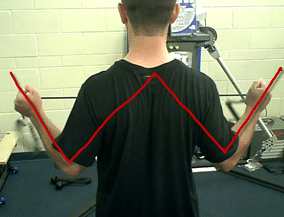
The other tidbit I would recommend, and the origin of the name “W” exercise, is that I like to keep a 90-degree angle at the elbow, which ends up forming a “W” when you reach the end range of external rotation. This happens because the lat muscle mass causes your arms to abduct a little bit of your body. I wouldn’t recommend trying to keep your forearms parallel to the ground.
If you perform the shoulder W exercise with thumbs back and keep your forearms parallel to the ground (and thus don’t form a “W”), I feel that you are really missing out on the scapula retraction and, more importantly, the scapular posterior tilt that you achieve when forming a “W.” Try it yourself, you’ll feel what I mean.
Realize that this isn’t rocket science. There are several variations of bilateral shoulder external rotation exercises, but I wanted to share my thoughts on performing the shoulder W exercise and why I prefer it.