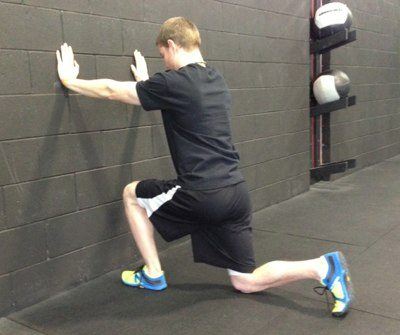

Deficits with ankle dorsiflexion mobility can have a dramatic impact on functional movements such as deep squatting, lunging, and the lateral step down. If you are familiar with the functional movement screen, you know that this is taken into consideration when a person does not grade out with a perfect score on many of the tests.
The Lateral Step Down Test
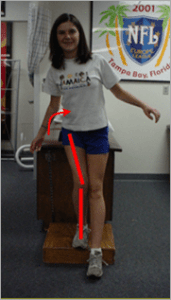 One component that I have always felt is missing from the functional movement screen (FMS) is assessing the lateral step down. I understand that the FMS needs to be applicable to a large variety of people and that the hurdle step test is included, but I have always felt I gain additional information from using the lateral step down test, especially in high level people.
I feel that the lateral step down test is an important test to include in your movement screening as it is often a movement that is dysfunctional in people with patellofemoral pain, patellar tendonitis, ACL injuries, and other lower extremity injuries. During the lateral step down movement, the body is challenged in a very dynamic position to produce a combination of lower extremity strength, foot and ankle stability, core stability, and probably most importantly the ability to eccentrically control or decelerate the weight of the body.
A common finding during the test is the person that can’t resist medial displacement of the knee, resulting in hip adduction, hip internal rotation, and pronation at the subtalar joint. This places the individual in a very disadvantageous position and makes them more susceptible to lower extremity injuries. When analyzing people with this dysfunctional movement pattern, weakness of hip abduction and external rotation is commonly found.
Ankle Dorsiflexion Tightness Alters the Lateral Step Down
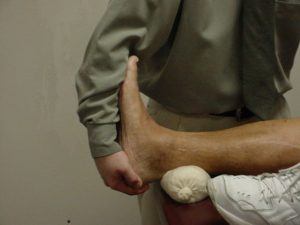 A recent study in JOSPT has found that ankle dorsiflexion restrictions can also cause poor quality of movement during the lateral step down test. Examiners studied 29 healthy women and coached them through the lateral step down test. The subjects were graded on the quality of their lateral step down with a 6 point scale. Results showed that subjects that performed poorly in the lateral step down test had a significant amount of ankle dorsiflexion mobility restrictions when measured in both weightbearing and nonweightbearing. Dorsiflexion was ~10 degrees more in subjects that scored well on the lateral step down test.
Interestingly, the authors did not find a correlation between hip abduction and hip external rotation strength with poor movement quality during the test. I was surprised by this finding but realize that there were some limitations of the study, such as the use of healthy subjects that were coached well on technique. I continue to believe this as experience and other past research has shown this, perhaps the limitations of the study can help explain.
In my experience, the three areas that I have focused on when someone does not score well on the lateral step down test are:
- Hip weakness, specifically hip abduction and hip external rotation
- Subtalar pronation
- Core stability
But the results of this study are going to make me assess ankle dorsiflexion a little more closely and be sure to include ankle mobility exercises to improve dorsiflexion. It makes sense that if ankle mobility is limited, the body would have to compensate to perform the task. In this example, to achieve greater depth of motion while stepping down, the hip strategy observed was potentially due to the lack of ankle dorsiflexion.